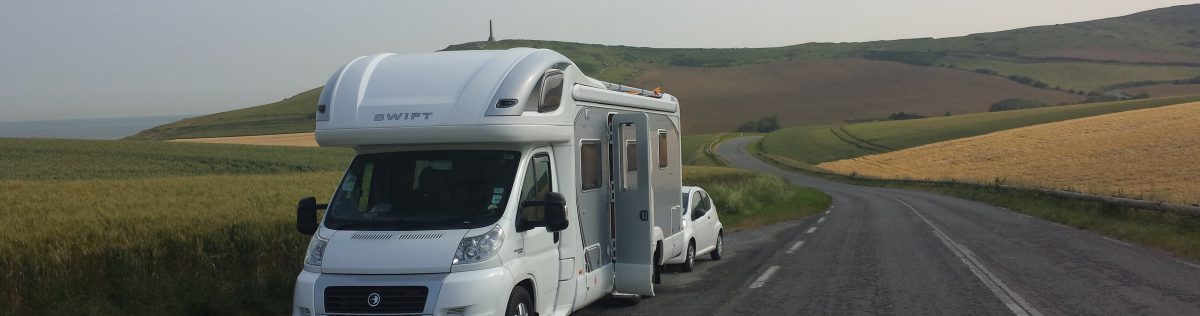
Heading south in Spain, from the mountains to the coast

The 2nd part of our Spanish travels taking us up to where we headed into Portugal.

User

You


Continuing our journey south from Banos de Fortuna we took the A92 motorway across the mountains towards Granada as we didn’t want to go along the Almeria (plastic) coast. My first mistake was thinking, and telling Calv, that we weren’t going very far – I thought it was about 60 miles, rather than the 160 miles that it actually was…Yes, I was in trouble! (The next step from La Peza to Loja was actually 60 miles).

However it was all worth it as La Peza was delightful. From the dedicated motorhome park-up we could see the castle on the other side of the town, and an Ermita on the other hill. Behind us we could see a mirador up a road that was definitely cyclable.

Walking to the castle in the morning entailed a steep downhill into town followed by, you’ve guessed it, a steep uphill to the castle. Along the way we saw old men sitting together on benches chewing the cud and being greeted by everyone who passed by 🙂 After visiting the castle we headed over to the other hill to visit the Ermita before going back to the van via a quick drink in Fernando’s bar, discovering a fully intact outdoor lavaderia along the way 🙂

After a spot of lunch we jumped on our bikes to cycle up the mountain to the mirador and a little further along a cycle route heading into the mountains. Coming back down the hill was quite hairy (for me anyway – I really don’t like the downhills!!)

We didn’t stay a 2nd night, but only because on our way in we had passed an area to stop beside a reservoir. This was only a few miles away on the road back up to the motorway; so we spent our 2nd night here.

Next up was a stop that I’d found in Loja. Well, the motorhome area itself was fine, being in a newer & slightly nicer part of town, but on walking towards the towers that we could see in the old town and wandering around a little we realised that it wasn’t the nicest and we were very happy to move on in the morning.

Our next destination was La Cala de Mijas. However, along the way we toyed with the idea of stopping in the car park at El Torcal (near Antequera) and doing a walk. Calv looked at the map and decided that he was going to go up THAT road. I was a little dubious, but just agreed and of course when we got to THAT road it was only suitable for a tractor and we would never even consider using it. So instead we went up the next mountain road, which wasn’t much better and joined the ‘main’ road via a very steep junction (luckily when we got there there was nothing coming!!) Unfortunately though we didn’t like the look of the El Torcal car park for staying in and as the weather wasn’t wonderful we moved on. We went via Antequera to get on the motorway on the last bit into La Cala.

We stayed 4 nights here, meeting new people, having nights out and also 1 get together in our van, which resulted in us not being able to move on the next day as originally planned…

Our next stop was just a few miles along the coast at Cabopino where we have stayed several times. This was definitely our last time though and we only stayed 6 nights rather than the 11 that we had originally intended. We did get some washing done though and met up with some friends who were staying nearby. We walked back to La Cala along the boardwalk one day – it’s a really pleasant walk now that the boardwalk fully connects both areas.

This area really isn’t cycle friendly but we did go out on our bikes a couple of times to do bits of shopping. On our first outing I had forgotten about the really steep culvert on our route; bad enough on the way but coming back the very steep upwards after the long drawn out downwards almost defeated me. I had to go back and have another go (with Calv’s encouragement of course….) He reckons that it’s a 1in3.

Next stop was Gibraltar where we stumbled upon a perfect park-up in a marina, with the imposing rock as our backdrop. We managed a run along the promenade in the morning and then a 10 minute walk takes you to the border crossing, where we showed not just our passports, but our parking ticket and proof that we were going home at some point! We had a pleasant wander around seeing many things that we hadn’t seen on our first visit – the Trafalgar cemetery where we found the grave of 1 of the sailors killed at the battle, the courthouse, the cathedral and the gates to the town.

Sitting down for a lunch of fish and chips, with several eateries to choose from I was stunned to realise that I recognised someone who was sat a few tables away from us – it was Justin who I went to school with and his wife Debs who had just arrived for a long weekend. What are the chances of not only being there at the same time but actually choosing the same place to eat at the same time 🙂

We then spent a couple of hours in the Lord Nelson pub tucked into the corner of the Casemates Square where we met another couple who were over for the weekend. We did our best to persuade them to get a motorhome!

Apart from a violent bout of food poisoning that night our visit to Gibraltar couldn’t have been much better!

Next up we discovered another perfect little camper stop nestled between Tarifa and Cadiz, on the Trafalgar coast, a haven for surf enthusiasts from around the world. Los Canos de Meca exuded surfer vibes, the beach was absolutely beautiful, the water warm and the food on offer simple yet satisfying. We reluctantly bid farewell after 3 nights to move on to our last stop in Spain before heading into Portugal.

Our final Spanish stop was in fact Seville, our overnight stop greeting us with views of the city itself. A short bus ride took us to the bus station at the Plaza de Armes from where we walked for about 10 mins to get to the centre. Despite encountering tourist crowds, meaning that we weren’t able to visit the cathedral or the alcazabar, and dining dilemmas (nothing suitable seemed to be open), the majesty of the Plaza de Espana and an impromptu flamenco performance made the visit worthwhile. I loved the Plaza de Espana having missed visiting when I first visited Seville as it was flooded and closed.

This section of our travels, each stop offered a different experience, from scenic vistas to unexpected reunions.

New adventures awaited in Portugal as we prepared to travel up the N2 route through the centre.

Stay tuned for this next chapter of our travels 🙂

Escaping for some Winter Sun

The first few weeks of our 2024 winter roadtrip taking in France, Portugal and Spain 🙂

We left the UK at the beginning of February hoping to find some cheerier weather for a few months.

However, the start of our journey through France was wet all the way. I mean it literally hardly stopped raining! Usually we take our time travelling through France (anything up to a week) but this time we were heading into Spain at the earliest opportunity (into Northern Spain), and had just 4 overnight stops (Dieppe on the evening we arrived, Marboue, Vivonne and Morcenx-le-Nouvelle). We managed a short walk out at 2 of the stops but otherwise ‘rain stopped play’!

As we crossed into Spain however, the clouds parted, revealing blue skies. We had no rain then for about 10 days. Bliss 🙂

Our first stops in Spain were the charming towns of Olite and Teruel, each offering a glimpse into the country’s rich history and culture. From medieval castles to quaint cobblestone streets and medieval architecture to red sandstone gorges just waiting to be explored.

We had visited Olite before en-route through Spain, but we didn’t stay and we couldn’t visit the Royal Palace as it was closed on that occasion. We did this time though and it was well worth it 🙂 Olite is a lovely old town with lots of narrow streets to explore.

Teruel was getting ready for an annual festival celebrating the doomed lovers that the city is famed for. This means that we were treated to drum practice for the whole evening! The town itself was adorned with flags and there were people everywhere, meaning that the cafes and restaurants were full to bursting. We did walk down to the town (which then entailed a steep uphill slog back to the van) and have a wander around. We had already walked around the red gorges that border the main road into the city.

Of course, this meant leaving the path and finding our own way down to other pathways and then having to try to find a suitable way back up 🙂 Again an uphill walk back to the van…
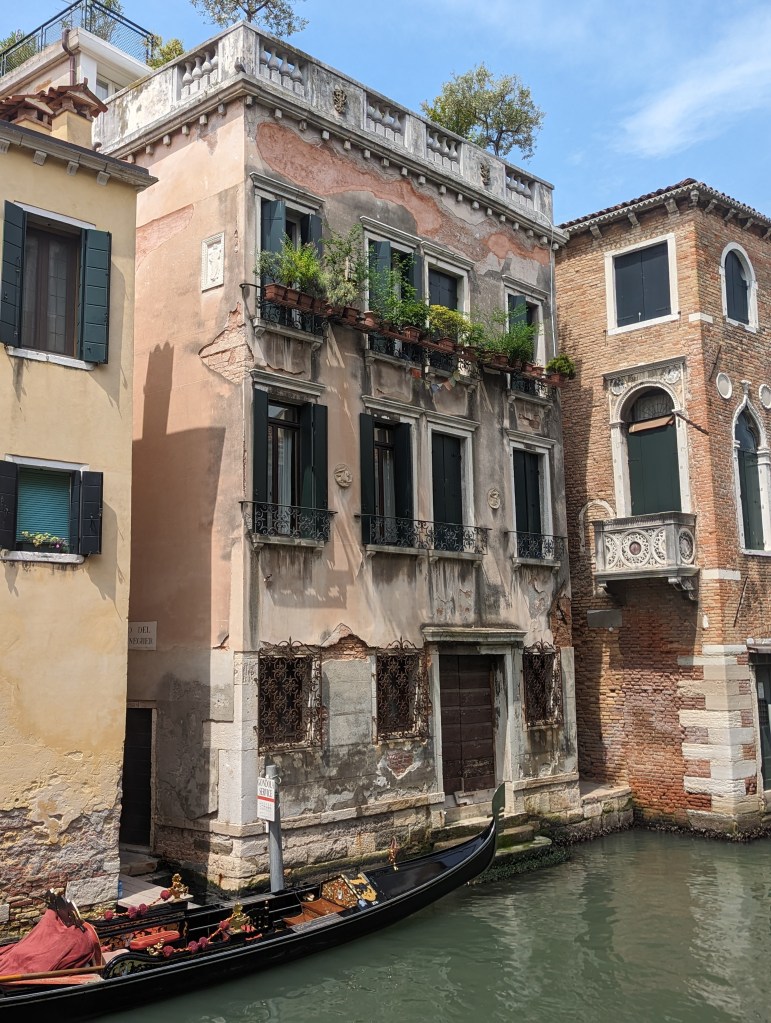
Teruel and Olite

We were now ready for some sun and relaxation so we headed to Alannia Costa Blanca for an 11-night retreat – we’ve been here before so knew what to expect.

On the way though we spotted a castle on a hill in the distance. We decided to go to investigate… As we got nearer it was clear that it was situated in a tiny little village and the way up was via a series of switchbacks. Imagine my surprise when Calv commenced driving up said switchbacks! This entailed some manoeuvring to get round each corner (and me with my head in my hands at times). We didn’t quite make it to the top but managed to park up safely and walk up to explore. Only there wasn’t a lot to explore as the castle was very much a ruin and the town had take over the majority of it. Good adventure though! (We had to reverse back down to the first switchback…)

Switchbacks up to Castillo de Moya

Once settled in Alannia we made it our mission to fully relax 🙂 We took advantage of the facilities on site; playing pool, using the bar, table tennis, tennis, sitting by the pool, playing their impossible pitch & putt course and using the site as a running track (managing several 5k runs).

However we did also get out on our bikes most days, mainly to go shopping in Catral, but also cycling along the country lanes behind the site. We found Abanilla and a very strange park, but not what we were looking for (as someone had told us about it), the site of the Abanilla concentration camp from the Spanish Civil War. However, we did some more research and were successful on another outing. There is nothing left of the camp but there is a sign up, and it was a somber reminder of the country’s tumultuous past, and we took a moment to reflect on its significance.

Site of the Abanilla Concentration Camp (Spanish Civil War)

This was just the start of our Spanish sejour and our next stop was another site that we have visited several times at Los Banos de Fortuna. The draw here are the spa pools and the quirky little town. There are also ruins of a roman bath, but these are currently hidden behind a large wall (we did go through a gap and have another look around though – ssh…)

We were the only British van on site but we had an evening out at Tina’s bar, where we chatted with Tina and Nicky and ate some fresh broad beans brought in by a Spanish regular, Mundo, the goat herder 🙂

We also tried to cycle across the desert to a nearby town, but had to abort as the winds were so high, with some really, really strong gusts. They didn’t bother Calv of course, but I was hating every second, so we turned around and explored the 3 abandoned houses that offered a little shelter on the way back 🙂

Abandoned house of Los Banos and the ruins of the Roman Baths

On leaving Los Banos we made our way down to the coast, but we stayed up in the mountains heading via Granada. We loved doing this and I will tell you about it in my next post 🙂

Until then, you keep safe and we’ll keep travelling 🙂

How to head home to the UK from Italy

Heading home from Venice we decided to head through Austria, so were able to visit Lake Garda and Verona on our way home 🙂

After 4 nights we reluctantly bid farewell to Venice. Our next destination: picturesque Lake Garda. On our way though we decided to stop in the historic city of Verona, a place steeped in romantic lore.

Our first glimpse of Verona was a pleasant surprise. We parked the van at a dedicated area near the rather impressive Porta Palio before heading off to walk into the city in the relentless heat of the day. Under normal circumstances we would have waited, but as we had only 1 night here we thought we should push on.

We first encountered the castle walls and another gateway randomly facing the river, and then made our way through a labyrinth of narrow streets and alleyways, each one revealing a piece of Verona’s rich history. The city’s architecture was a delightful blend of medieval and Renaissance styles, with charming towers, arches and frescoed facades around every corner.

One of the highlights of our Verona adventure was discovering Juliet’s house, or at least the 15th-century residence attributed to her. It was a lovely building with its iconic balcony, but whilst there were many people who seemed to be stroking the left breast of Juliet’s statue in the hope of finding true love, we were struck more by the sheer commercialism of the house, beautiful as it was.

Just a stone’s throw away, we also found ‘Romeo’s house’. While the authenticity of these sites may be debatable, there’s no denying the lure they have on tourists (more so Juliet’s house).

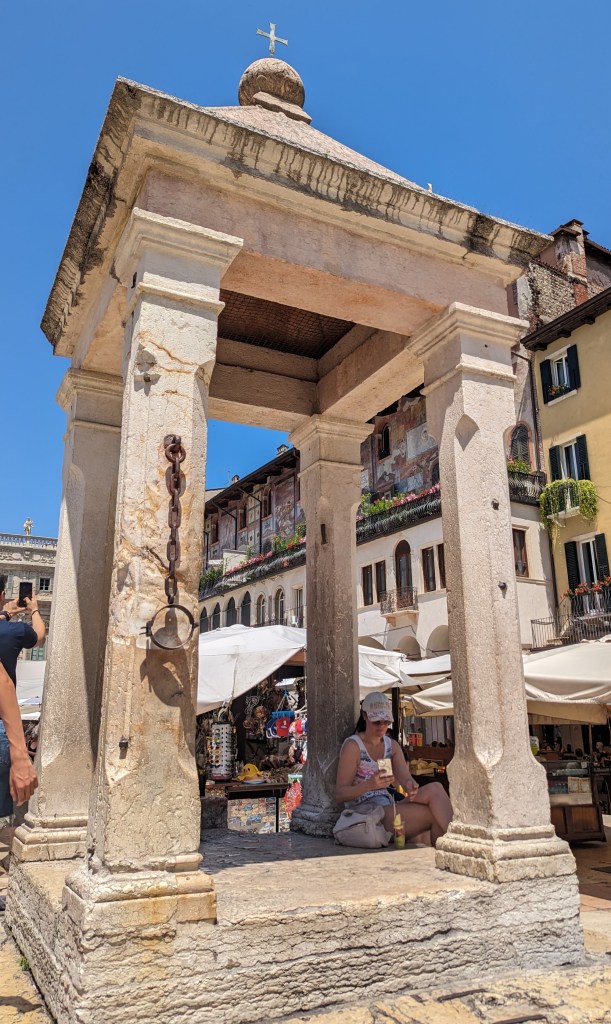
Verona also revealed itself as a treasure trove of historical and artistic wonders. We stumbled upon ancient mausoleums that spoke of a bygone era, a rather disturbing set of stocks with a metal neck ring in the centre of a piazza, their solemnity contrasting with the romantic legends that surround the city.

As the day turned to dusk, we sat outside the van with a neighbour, a young Israeli lady travelling on her own towards Norway with her dog Lady. She had the much better idea of wandering into the city in the evening when the heat had abated somewhat!

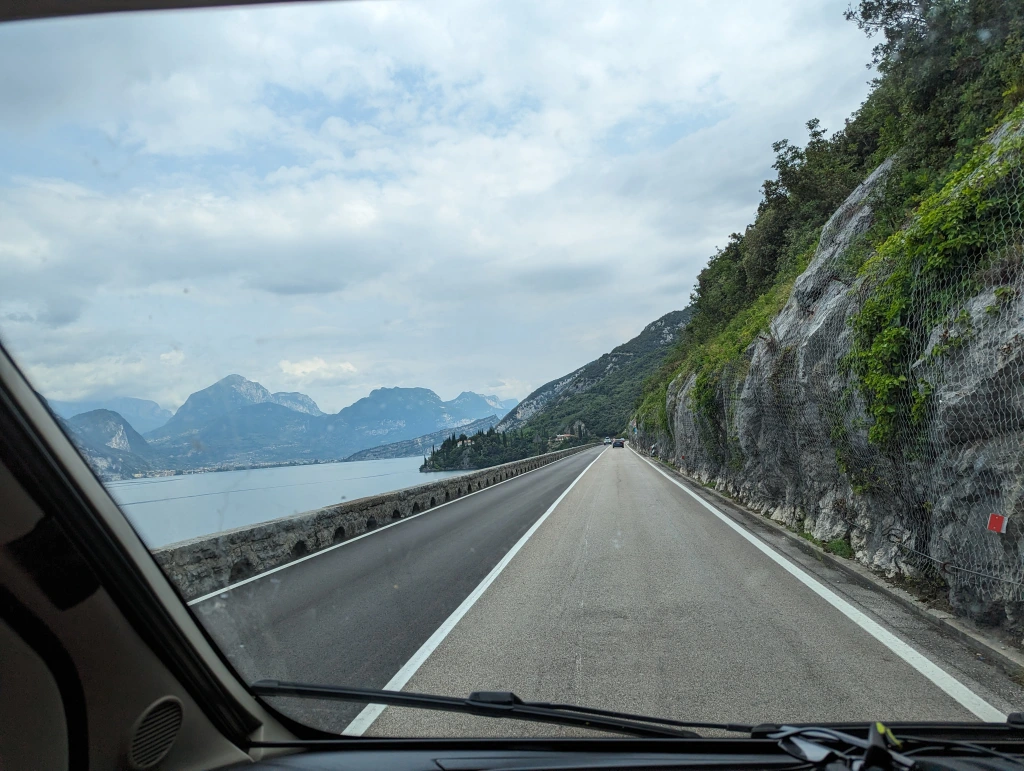
After a memorable night in Verona, our adventure continued as we made our way to Peschiera, a charming town nestled on the shores of Lake Garda.

We decided on Camping Butterfly, although we quickly realized that it was a rather regimented place with its specific schedules, including designated times for taking out the rubbish.

On our day in Peschiera we cycled along the scenic shores of Lake Garda, heading towards the town of Garda itself. The path proved to be challenging at times, especially the beach section, but the breathtaking views of the lake made it all worthwhile. We paused for a leisurely lunch and a stroll in the lovely town of Lazise, where we discovered a hidden gem of a bar called Nautica. It turned out to be one of the best dining experiences of our trip, with delicious food and a warm atmosphere.

On our way back, we couldn’t resist the temptation to cool off with a refreshing swim in the lake. Thankfully, we had remembered to bring our water shoes, which proved essential for navigating the stony lakebed.

Our second evening in Peschiera took us to a bustling bar, Mida’s Strube, where we found ourselves in the company of Italian triathletes on a training run/swim/ride – we think they may have been international competitors 🙂

As much as we enjoyed Peschiera, we decided to move on to Garda, where we found a dedicated parking spot just a short walk from the lake. This location was perfect for us, and we once again took a dip in the lake, even though it was a bit rockier and less convenient than our previous swim – still a welcome respite from the heat.

In Garda, we made a big mistake by choosing an empty lakeside eatery. Initially presented with an a la carte menu that didn’t quite appeal to us, we were surprised by the waitress’s lack of grace when clearing our table. After a while, we decided to ask another waiter for a different menu – which they did have. We enjoyed our meal and drinks but were taken aback by a hefty bill, including a cover charge of 4E each, reminding us of the importance of choosing wisely when dining in touristy areas. We were really annoyed with ourselves as we are fully aware of these potential issues…

A stroll around Garda led us to a brass band playing, a delightful déjà vu from a previous visit to the town. We had hoped to find the market to replace a cherished tablecloth from years ago, but alas, the market day was the next day, and we missed it as we drove away.

Our final stop in Italy took us to South Tyrol, just south of the Austrian border, where we explored the stunning scenery, admired mountain views, and stumbled upon a mysterious circle of standing stones. As we crossed into Austria and headed towards Germany, we reflected on all the memories that made our 2023 trip through Italy an unforgettable journey, at the same time we looked forward to our meander home through Germany, France, Luxembourg and Belgium, which turned out to be a rather wonderful few weeks 🙂

We stayed: Porta Palio, Verona

Camping Butterfly, Peschiera

Garda Parking, Garda

Should you visit Venice? Here’s our view

We nearly missed Venice as I had an idea I wasn’t going to like it… How wrong I was! We both absolutely loved it 🙂
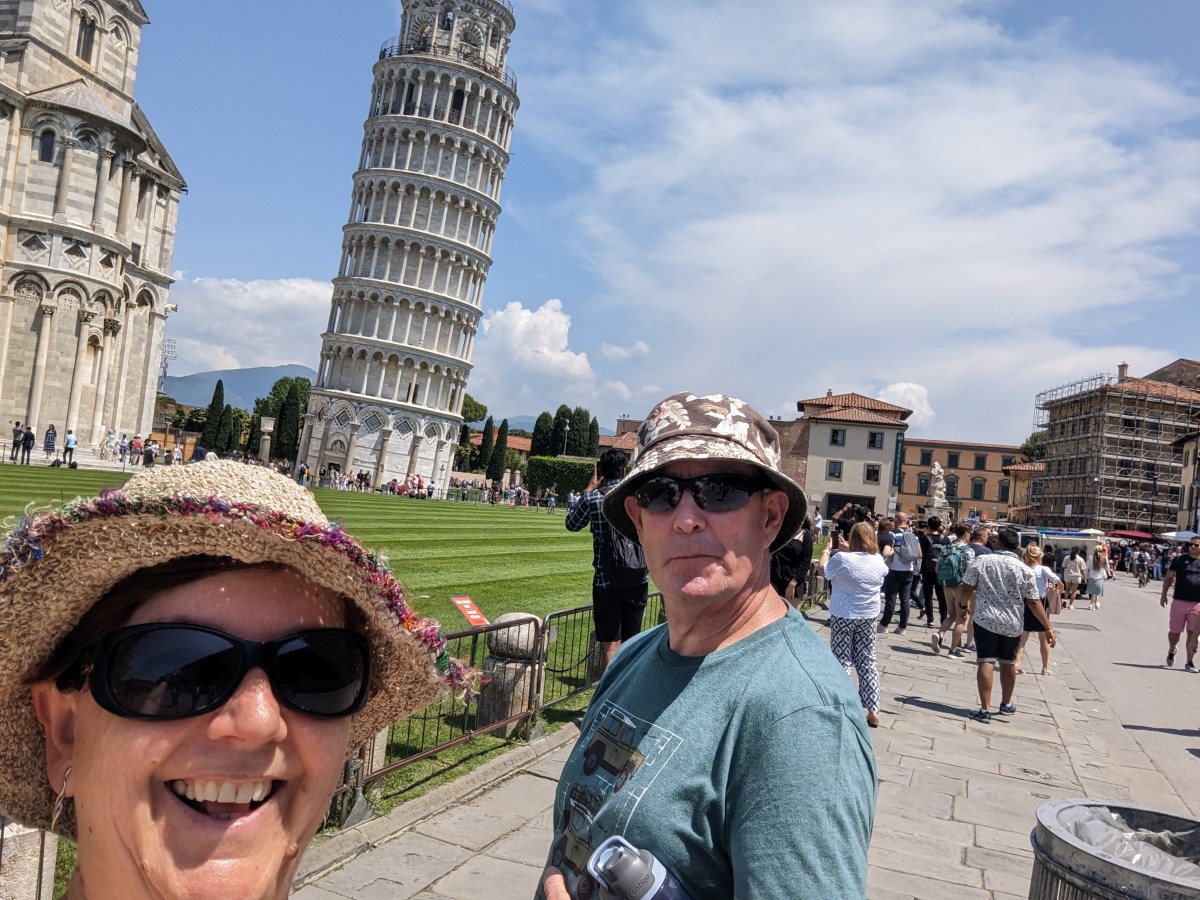
A Whirlwind Romance with Venice: Three Unforgettable Days

Venice, a city born from the sea, a place where every corner holds a piece of history and every canal whispers tales of its past. Our journey through this enchanting city began as we disembarked the bus at Piazzale Roma Station. From here we set out to discover the heart of Venice.

Day 1: The Grand Unveiling

Our first day was a whirlwind of awe and wonder. The moment we stepped onto the narrow streets, Venice cast its spell on us.

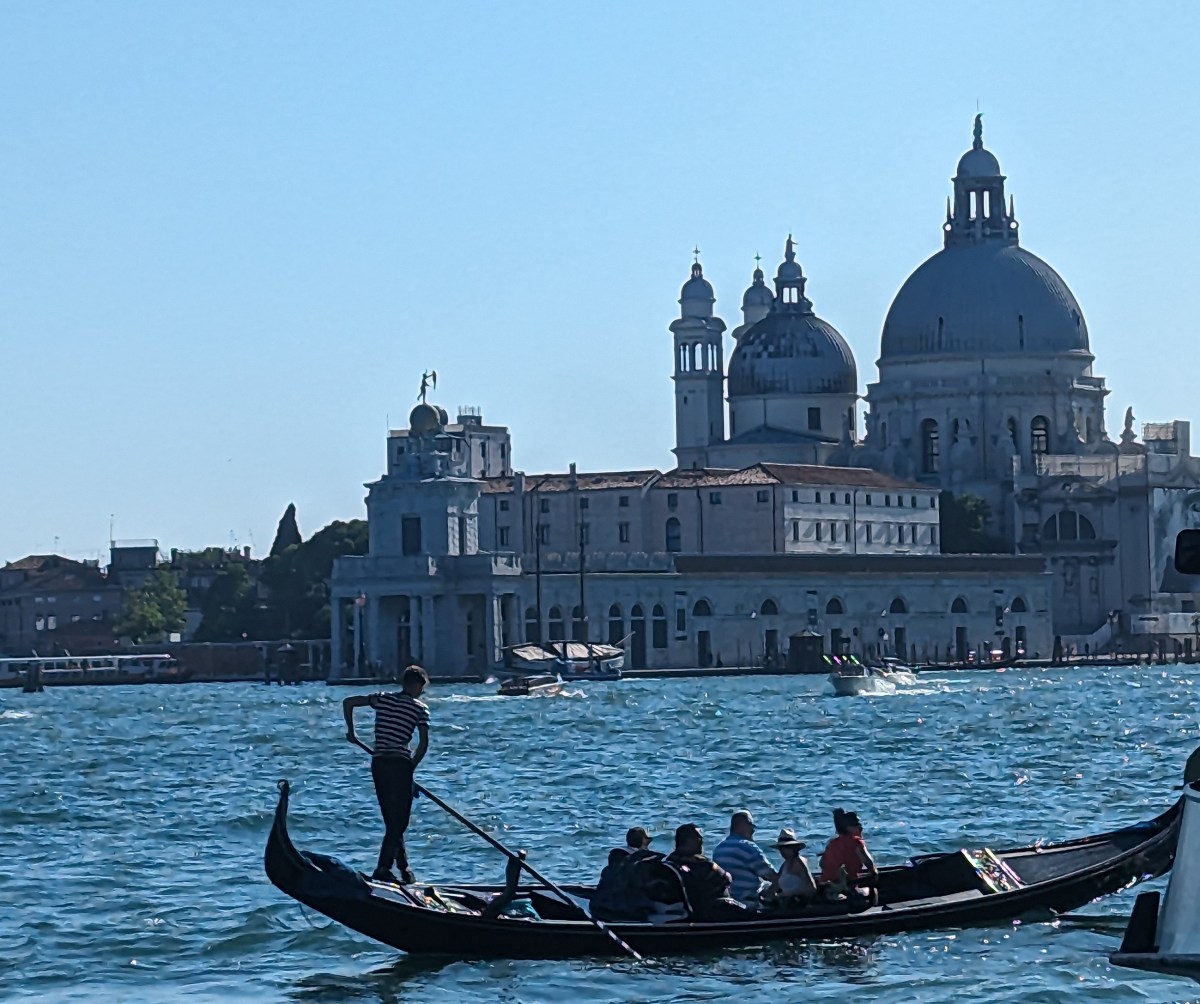
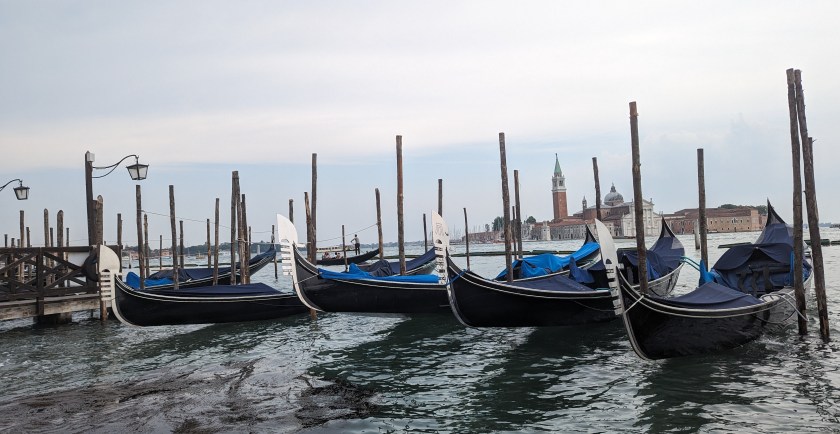
Calv was instantly smitten with the skill of the boatmen, marvelling at how they all avoided each other in the busy waterways.  If it had been up to him we would never have made it past the 1st bridge!  As it was we aimed to cross as many bridges as possible, an aim which was helped as we took a few wrong turns along the way (I know – it’s a surprise…!)

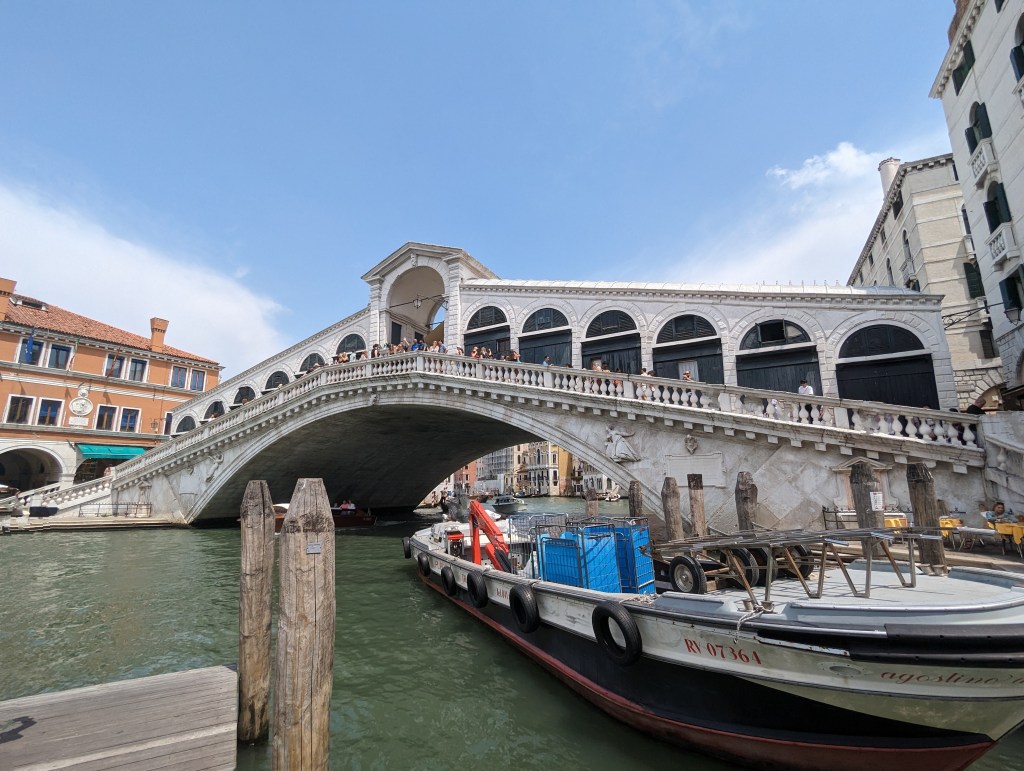
The Rialto Bridge was the first main bridge we found; a magnificent architectural feat, greeted us with a bustling crowd of tourists. It was impressive, indeed, but oh, the crowds!

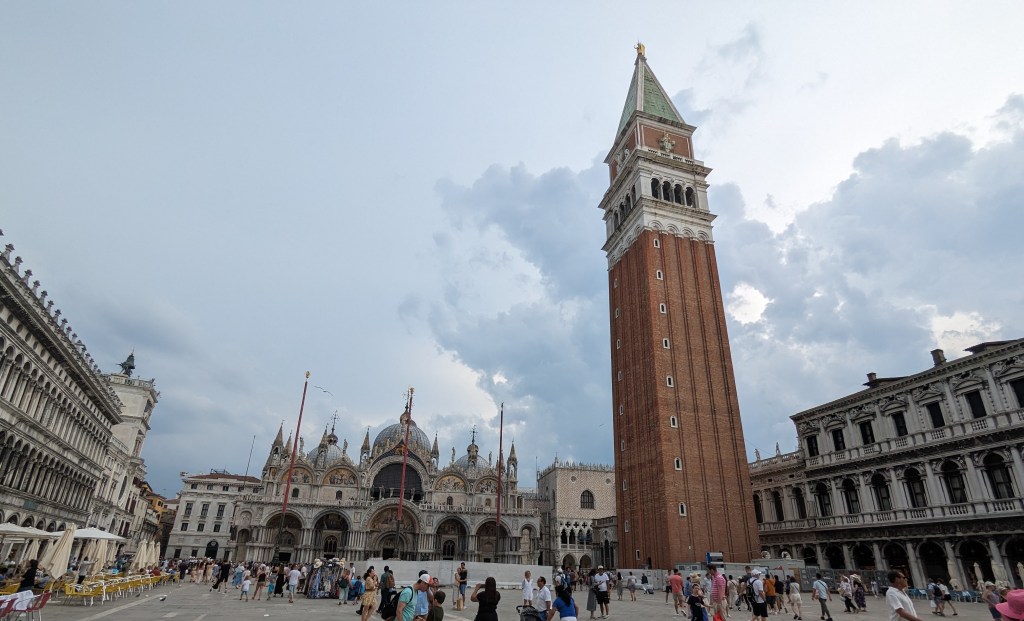
We moved on to St. Mark’s Square and its stunning basilica. The beauty was worth the wait in the queue, although the conflicting signs about entry fees left us a bit puzzled.  Just to be clear you do have to pay to visit the basilica, and extra to visit the Pala D’or (the golden altar) inside.  We didn’t pay the extra, but did catch glimpses of this wonderful altarpiece.

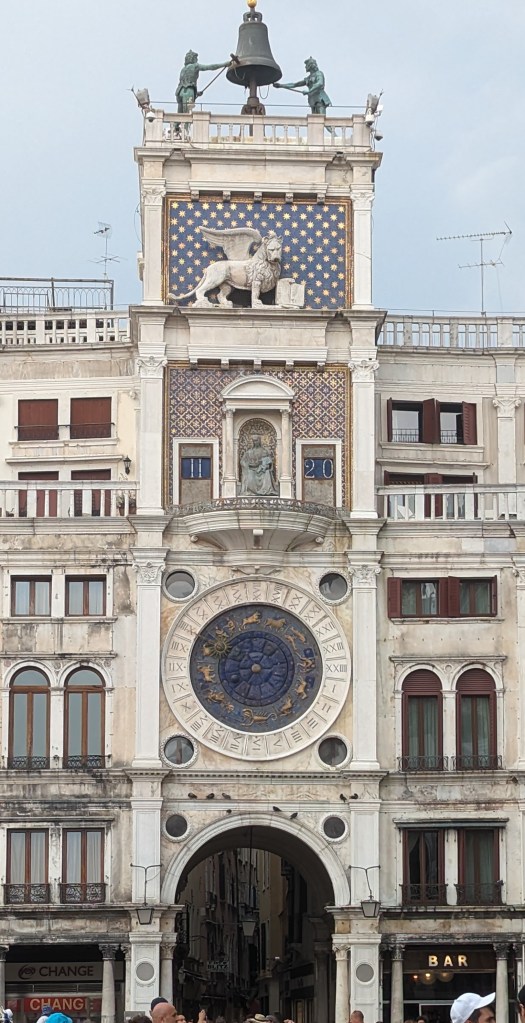
Whilst standing in the queue we were able to appreciate the outside of the basilica and the Doges Palace, the bell tower and the unusual clock that overlooks the square.

As we stepped inside the basilica, the wonderful mosaic-adorned ceilings and exquisite floors captured our attention. Read more about the basilica here.

We next stumbled upon the Bridge of Sighs (just a short hop from the square), with its romantic yet dark history. Legend has it that condemned prisoners sighed as they crossed from the inquisitor’s office to the prison, although this tale may be more fiction than fact (well it is actually – read about it here).

Whilst Calv loved watching the boat ballet (and I do agree the boatmen and the gondoliers were extremely skillful) my favourite thing to look at as we walked around the city were the shop windows showing off authentic Venetian masks, and the costumiers with historical costumes on display. They were truly amazing (and there were a lot of them). Sadly my budget extended only to a purchase from a stall (which was pricey enough!!)

Day 3: Exploring the Unplanned

Unfortunately, illness confined me to quarters on the second day. However, on the third day, we were back on our feet.

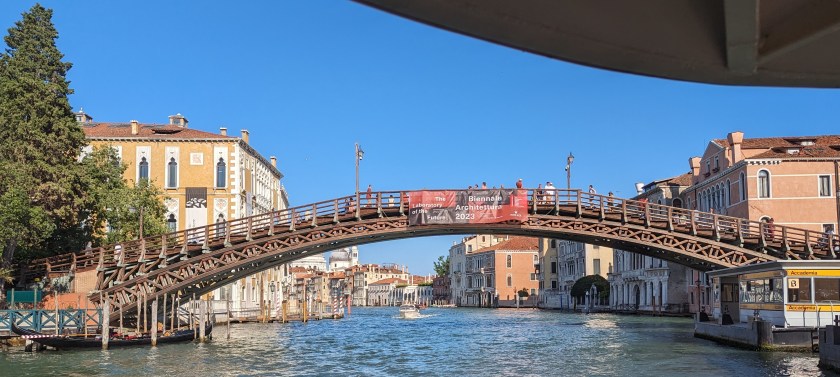
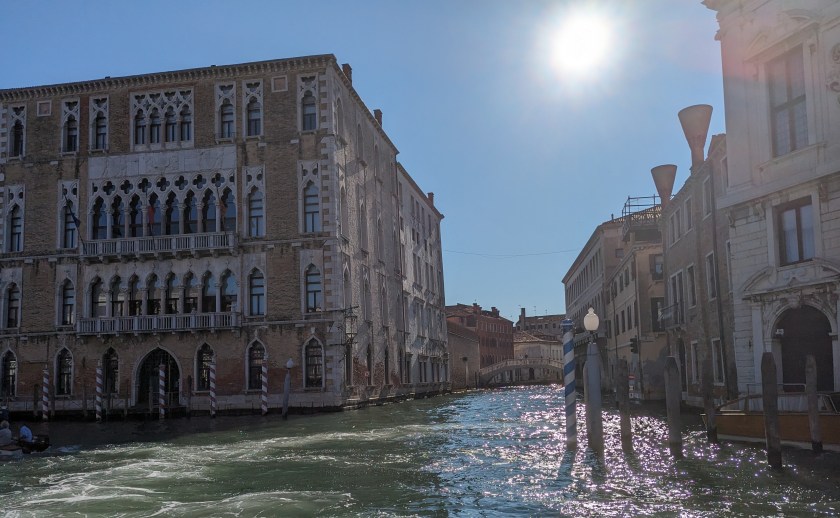
On our third day, we chose to forgo the pricey gondola ride (80E for 40 mins), opting instead for a 25E each day boat ticket. We used this to ferry us to the islands of Murano, famous for its glass, and Burano, renowned for its colourful houses and lace. The cruise along the Grand Canal at the end of the day was a highlight, revealing Venice’s intricate beauty from the water; and of course seeing many buildings that aren’t visible except from the water.

Despite taking a few unintended detours at the beginning of the day (we had been aiming to walk to a particular pontoon via the Ghetto) but under the scorching sun, we eventually cut this plan short and boarded a waterbus at an earlier pontoon to head out first to Murano, passing the intriguing cemetery island on the way.

Murano was a treasure trove of glass creations, with workshops and shops scattered across the island. Its ageing buildings added to its rustic charm. Burano, our next stop, offered a burst of colour with its picturesque houses and intricate lace shops. There was also another leaning tower here – they appear to be quite abundant throughout Italy (although none as impressive as the iconic Leaning Tower of Pisa). Both islands were beautiful. A little quieter than the main island (although that’s not really saying much) and therefore with a different vibe. There are plenty of canals and bridges still to explore. Definitely worth a visit.

The journey back to Venice was a crowded one, and also a long one, which meant we regretted our decision not to take a seat when we had the opportunity. Back at the main island we disembarked at San Marco, headed down a couple of pontoons to hop on Line 1, which took us all the way along the iconic Grand Canal, revealing one architectural marvel after another. It was genuinely a highlight and I would say is not to be missed 🙂

Venice, a city I had been unsure about, turned out to be an absolute delight. Its magic lies not just in its famous landmarks but in its labyrinthine streets, vibrant canals, and the sheer joy of getting lost and finding narrow dead end streets (meaning you come to a canal with no bridge to cross). If you ever have the chance, Venice is a must-visit, a city that will steal your heart and leave you yearning for more.

We stayed: Camping Serenissima

Our next stop: Verona (staying at a cheap sosta within walking distance)

Fulfilling a Childhood Dream: Exploring Pompeii, Herculaneum & Vesuvius

A summary of our time in Pompeii visiting the famous ruins, Vesuvius and Herculaneum

Introduction: Visiting Pompeii has been a long-held childhood dream of mine, and finally, the time came to visit & explore the ancient city. We stayed on the outskirts of the city which meant a rather uninspiring and not particularly enjoyable walk of just over 1-1.5 miles into Pompeii; note, we had to endure this walk 6 times (3 x there and back), but it was worth it for what we saw. Pompeii exceeded all expectations and proved to be a place where time seemed to stand still.  Ever since our visit Calv has commented with ‘It’s not 2,000 years old though is it?’ to every new sight that we’ve seen…. We didn’t limit ourselves to visiting Pompeii though – we also ‘conquered’ Vesuvius and explored Herculaneum 😊

Pompeii: A couple of people advised us that we needed to allow about 2 hours to exploring the ruins…I know, right??  2 hours??  Were they mad?  We could have spent 2 days nosing around and probably still not seen everything.  We spent about 5 hours exploring and barely scratched the surface.  Our feet were screaming at us by then in the heat; we did intend to go back a 2nd day but by the time we got back from Herculaneum (and knowing we still had another 1.5 miles to walk) we simply couldn’t face it (I’ll just have to return another time)  

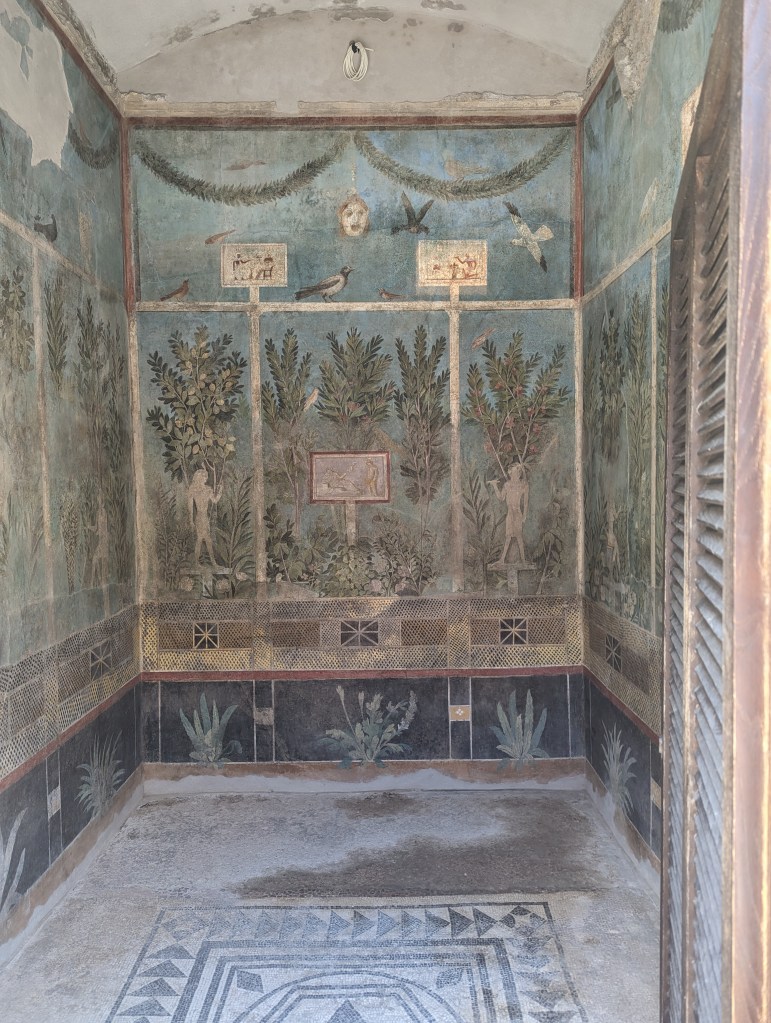
Wandering through the ancient streets, we marvelled at the remarkably well preserved ruins, the wheel ruts along the streets, the high pavements and stepping stones across the streets, the numerous ‘fast-food’ outlets with the amorphae still in place, the mosaics, the friezes, the fountains – the list is endless.  The ampitheatre was amazingly well preserved.  We were aware of many archaeologists working around the site uncovering more of it all the time (I think that only 2/3 of the site has been uncovered so far) – you can see the depth to which it was buried where excavations have yet to begin. 

Finally we wandered through the ancient burial area before viewing the preserved skeletons – they’re actually reproductions that you see, but very poignant nonetheless.

It was a simply amazing visit and I cannot recommend it highly enough.

Note:  If you enter near the Ampitheatre entrance there is likely to be less of a queue (we didn’t even have a queue – we thought we did but, we got into the queue only to realise that it was actually for the audio guides!)  We just needed to go to the ticket machine and buy our tickets and go on through 😊

‘Conquering’ Vesuvius: We wanted to go up Vesuvius and, preferably, look over the crater but we were being offered ‘tours’ for 45E each, that consisted of, in effect, a taxi ride to Herculaneum and then up to Vesuvius (not including tickets), so we decided to make our own way to both sites. However, our plans hit a roadblock when we discovered that tickets to see the crater were sold out for the next two weeks. No doubt due to the opportunistic operators buying up all the tickets so that tourists have little choice if they want to see the crater. Determined to explore on our terms, we managed our own transportation (we used the local bus and were lucky to get a fairly sane bus driver) and saved a significant sum of money (about 50E), AND saw just as much as we would have done if we’d fallen for it.

On finding the ticket office closed and therefore a short hike up to the crater closed to us, we took an alternate route up the mountain, which afforded us much the same views as we would have seen the other way (but without the crowds).  We could now easily see that Vesuvius is actually a volcano within a volcano as we could see the outline of the older Somma clearly.  

Calv genuinely believed that we would fool ‘the authorities’ and make it up to the crater on this alternative route…. He was proved wrong when we were stopped by a ranger and asked if we had a ticket (it costs 12E each to look in the crater… assuming you can get a ticket that is…)

We loved the hike that we were able to undertake but, in all honesty, I find the hike up and the views from Snowdon to be very much more stunning. Everyone’s different and I’m sure there will be those who disagree with me on this (not many though!!).

Herculaneum: Pompeii’s Lesser-Known Gem

While Pompeii often steals the limelight, its smaller counterpart, Herculaneum, offers an equally interesting view of the calamitous events of 24th August 79BC.

After our adventures in Pompeii and conquering Mount Vesuvius, we hopped on a commuter train from the same location that we had taken the bus, ready to explore the lesser-known ruins of Herculaneum. we needed to use was the commuter train and couldn’t help but notice the need for modernization throughout the whole train system (something that has been clear to us on most of our train journeys in Italy). However, amidst the worn-out stations and dated trains, we  did notice one station that had either been recently upgraded or was completely new—hopefully, for the Italians who have to use this infrastructure daily, a sign of things to come? The short ride to Herculaneum was a true reflection of the local daily commute, adding an authentic touch to our overall experience and what awaited us at Herculaneum made the journey worthwhile.

On arriving in Herculaneum (Ercolano as it is known nowadays) a brief walk from the train station brought us to the entrance to the ruins. As we crossed the bridge, we were able to look over the entire site – it is vastly different in size to the Pompeii ruins.  We could see whole buildings along whole streets, some with 2 stories still intact.  Due to the nature of the explosion and the fact that Herculaneum was much closer than Pompeii it was buried in a different way, from the bottom up, which meant that buildings were less likely to collapse and therefore the site seems to be more complete.

The ruins of Herculaneum, while smaller than Pompeii, were no less impressive. Our eyes were immediately drawn to the remarkable 9-meter-long wooden boat, a fascinating artifact that showcased the advanced maritime technology of the time. Additionally, the abundance of gold jewellery on display transported was amazing for the fact that you could imagine many of the pieces being on display in any jewellers today.

While some areas, such as the “urban baths,” were closed during our visit, we made it a point to explore all accessible sections. Learning from our previous experience in Pompeii (aka a ‘scatter gun approach’), we became more circumspect, ensuring that we didn’t miss any hidden corners or intricate details. Herculaneum, with its well-preserved structures and intimate atmosphere, allowed us to immerse ourselves in the daily life of its ancient inhabitants.

Once satisfied that we had seen everything, we treated ourselves to a light lunch at VIP Burger, a nearby eatery. The friendly staff seemed delighted to have customers and provided exceptional service (sadly not always evident during our trip). We even encouraged fellow travellers to take a seat and order here – it was a simple lunch but very tasty 😊

With our feet tired from hours of walking and my long-held dream finally fulfilled, it was time to bid farewell to Pompeii, Vesuvius and Herculaneum and embark on the next leg of our journey—heading towards the East Coast.

Conclusion: Visiting Pompeii fulfilled a cherished childhood dream, immersing us in the rich history and awe-inspiring ruins of this ancient city. The experience taught us that two hours are simply not enough to explore the vastness and intricacies of Pompeii’s archaeological marvels.  Having said that, 2 hours is almost enough time to explore Herculaneum- we would perhaps suggest that you go to Herculaneum first, and then Pompeii on a different day. Additionally, our conquest of Mount Vesuvius, despite the unexpected challenges, rewarded us with remarkable views and a sense of accomplishment. As with any journey, it’s not just the destination that matters, but also the lessons learned and the memories created along the way.

Where we stayed: La Terraza di Hermes

How to get from Rome to Pompeii when on a Motorhome Roadtrip

Our journey from Rome to Pompeii – seeing more of Italy. Includes links for reviews of where we stopped overnight 🙂

Introduction: Travelling through Italy offers an incredible array of historical and cultural treasures to explore. As we bid farewell to Rome, we headed to the captivating Villa Adriana (on the recommendation of a friend), the surprise that was Anagni, the beautiful Montecassino Abbey arriving eventually in Pompeii to visit the ruins. This was to be my main stop of the trip (i.e. the one that if I could only go to 1 place then this was it) being a long held dream of mine to visit.  Find out in my next post if it lived up to expectations!

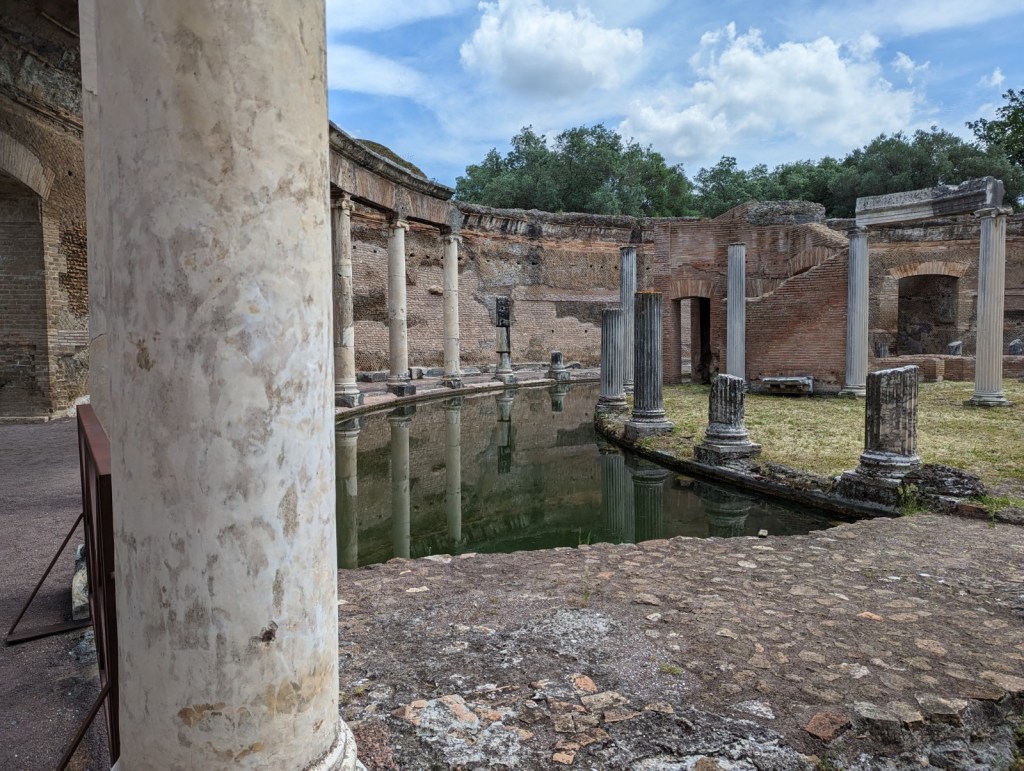
Villa Adriana: offered a small glimpse into Ancient Roman Luxury. Leaving Rome, we headed towards the Villa Adriana (Hadrian’s, rather lavish, present to himself), located just outside Tivoli. The drive was interesting at the end, as the main road in (itself narrow and through a residential area) was closed so we had to negotiate the very narrow streets and the school run!!

This is a UNESCO World Heritage site which was once the opulent retreat of Emperor Hadrian. As we strolled through the sprawling complex, we were stunned by the sheer size and grandeur of the imperial palace, stunning gardens and intricate architecture.  My favourite bit was the island inside a moat inside a theatre where, apparently, Hadrian really did retreat.  From the villa. That he built for himself….

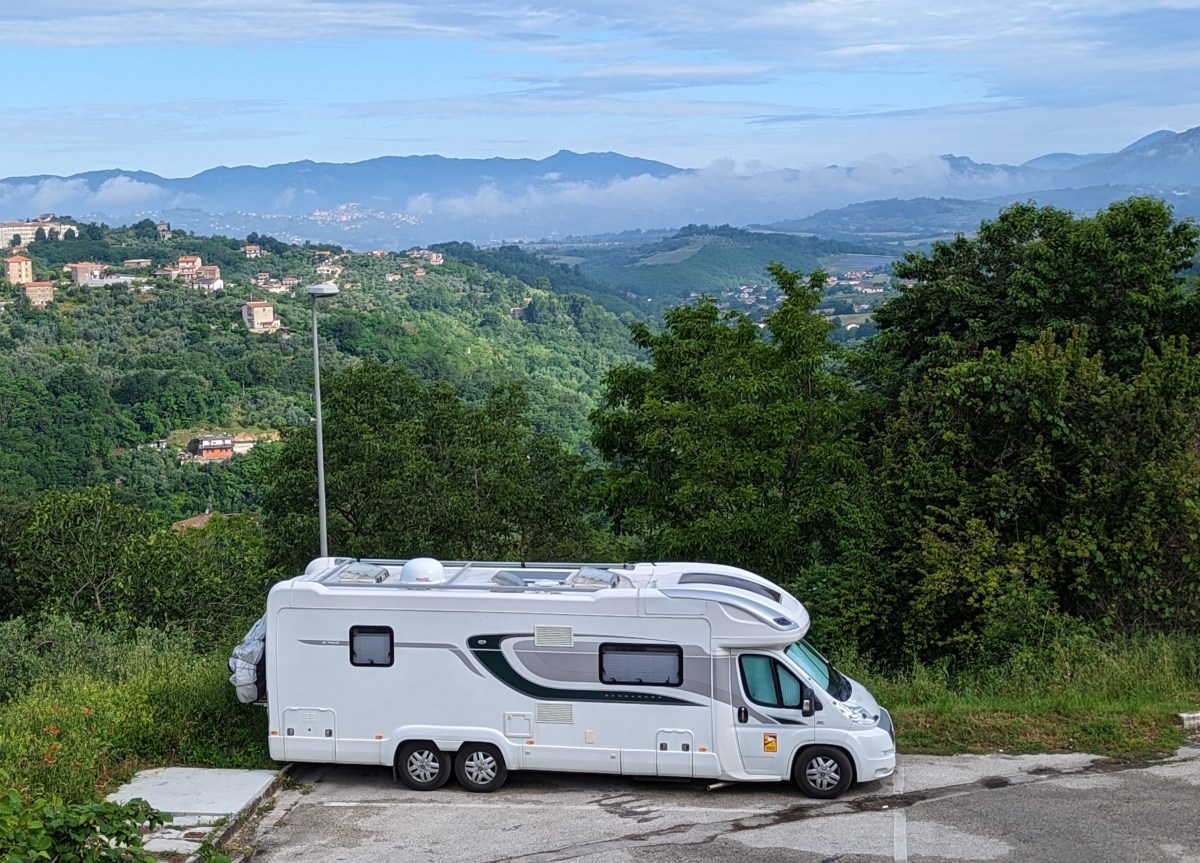
Anagni: Moving on, we found a stopover up in the hills next to a town called Anagni (Citta dei Papi)  Quite a drive up and around the bottom of the old town to find our spot, but what a view we had!  

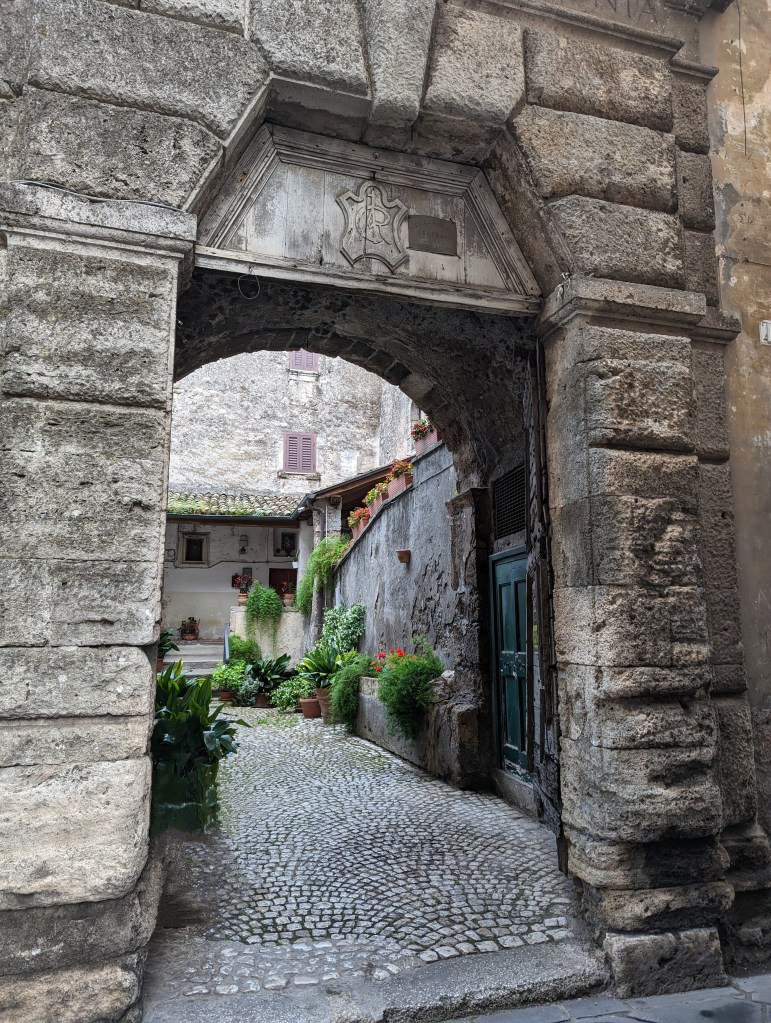
In the morning we decided to go for an early walk around the town to see what it was like.  Well it was a real surprise!  Narrow streets led straight to a cathedral and bell tower (closed at this time on a Saturday morning, although the bells still rang!)  Beautiful narrow, quaint streets leading to equally charming houses brimming with flowers and shutters, we were capitvated by the charming atmosphere. Even the usual Italian traffic racing through the (supposedly pedestrian) streets couldn’t spoil our initial impressions.

Anagni turned out to be much larger than we had anticipated, revealing hidden gems, tight links to a number of Popes (hence Citta dei Papi) and wonderful views at every turn. It was a most pleasant and unexpected detour that we were really pleased to have discovered.

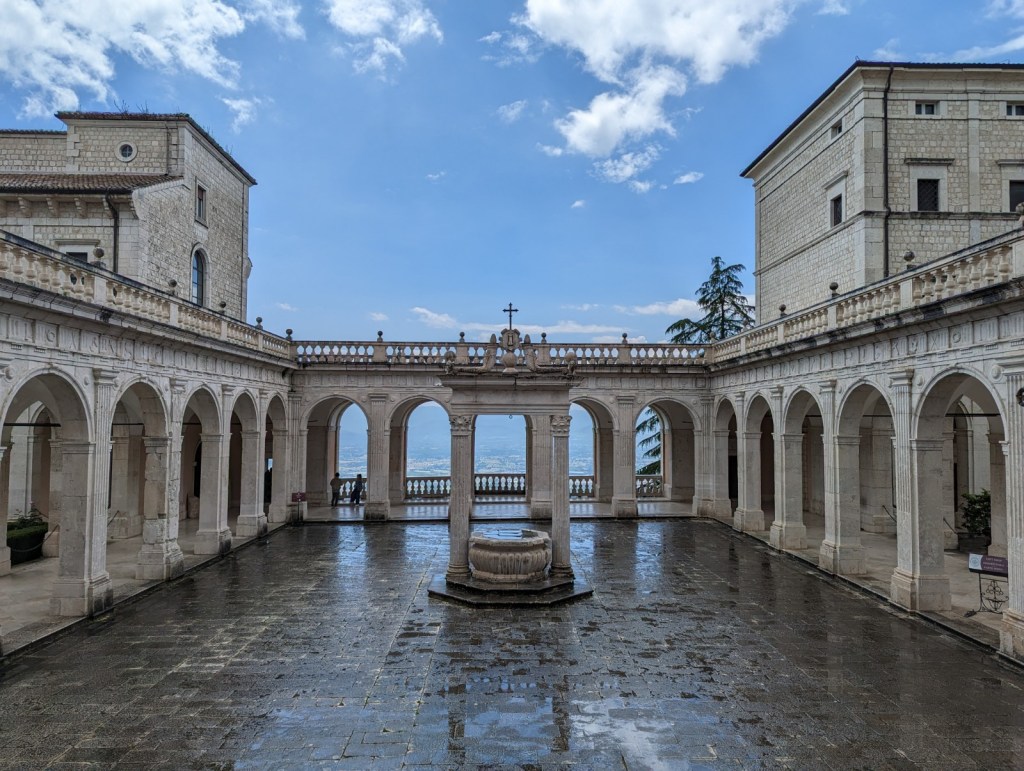
Montecassino Abbey: Our next destination for an overnight stop was the historic Montecassino Abbey, known as the birthplace of the Benedictine Order.

I’d spotted this as I’d been plotting out possible routes to Pompeii from Rome.  The only thing putting me off was the clear switchbacks on the map, but Calv gave me one of his looks when I mentioned this, so up we went!! 

Perched atop a hill, the abbey offers breathtaking panoramic views of the surrounding countryside. However, reaching it proved to be quite an adventure. The narrow road leading up to the abbey featured six treacherous switchbacks, and our encounter with a coach made for an exhilarating and nerve-wracking ascent.  (There’s a video of this event on my Instagram feed if you’re interested 😊-https://www.instagram.com/reel/CtT6GqtIKxd/) Nevertheless, the stunning beauty of the abbey and its rich historical significance made it all worthwhile.

I didn’t realise that this was actually the site of a huge WWII battle, and it made sense that the abbey looked so ‘new’ when I discovered that it has been rebuilt twice, the last time being after the war.  The abbey is well worth a visit, particularly the crypt of the cathedral – I’ve never seen anything like it before!

Pompeii: I assumed that it was best to follow the SatNav on arriving in Pompeii and heading for our stopover – when will I learn?!. Instead she (yes, it’s definitely a she I’m afraid) lead us through the congested centre of town before I managed to takeover and direct us in a more sensible manner. At least we now knew exactly how to get back to the ruins on foot when we were ready to visit the following day!  We also had wonderful views of Vesuvius (an ever changing view as the clouds scudded across the sky and the thunder storms came and went).

I will deal with our visits to the ruins of Pompeii and Herculaneum and our jaunt up Vesuvius on the local bus in a separate post 😊

Conclusion: All of the sites mentioned here are definitely worth visiting.  If you only have time for 1?  Not counting Pompeii (not dealt with that yet) it would be MonteCassino 😊

Where we stopped:-

Anagni

Montecassino

Pompeii – la Terraz di Hermes

What is it really like Exploring Rome? The Reality

3 days spent exploring Rome and still not sure we saw it all! However, we saw everything that we wanted to 🙂

Introduction: Rome, the eternal city, is a treasure trove of history, art, and culture.  Staying in a hotel in the heart of the city on a traditional city break can be exhilarating, but the way in which we travel  offers a vastly different experience as we experience Rome proper, rather than just the edited highlights.

In this blog post, I will share our experience of staying in Flaminio on the outskirts of the city, taking the train in with ordinary residents and commuters from Due Ponti, and exploring the iconic landmarks of Rome in a span of four days (including 1, very necessary, day off!).

Day 1: A Journey through Ancient Rome: Our adventure began with a train ride from Due Ponti, a serviceable ‘updated’ station (1 day the turnstiles weren’t working; another day it was the ticket machine), sitting alongside the no longer used old station; although this is likely due to laziness I did love seeing the old station with the blocked off underpass 😊

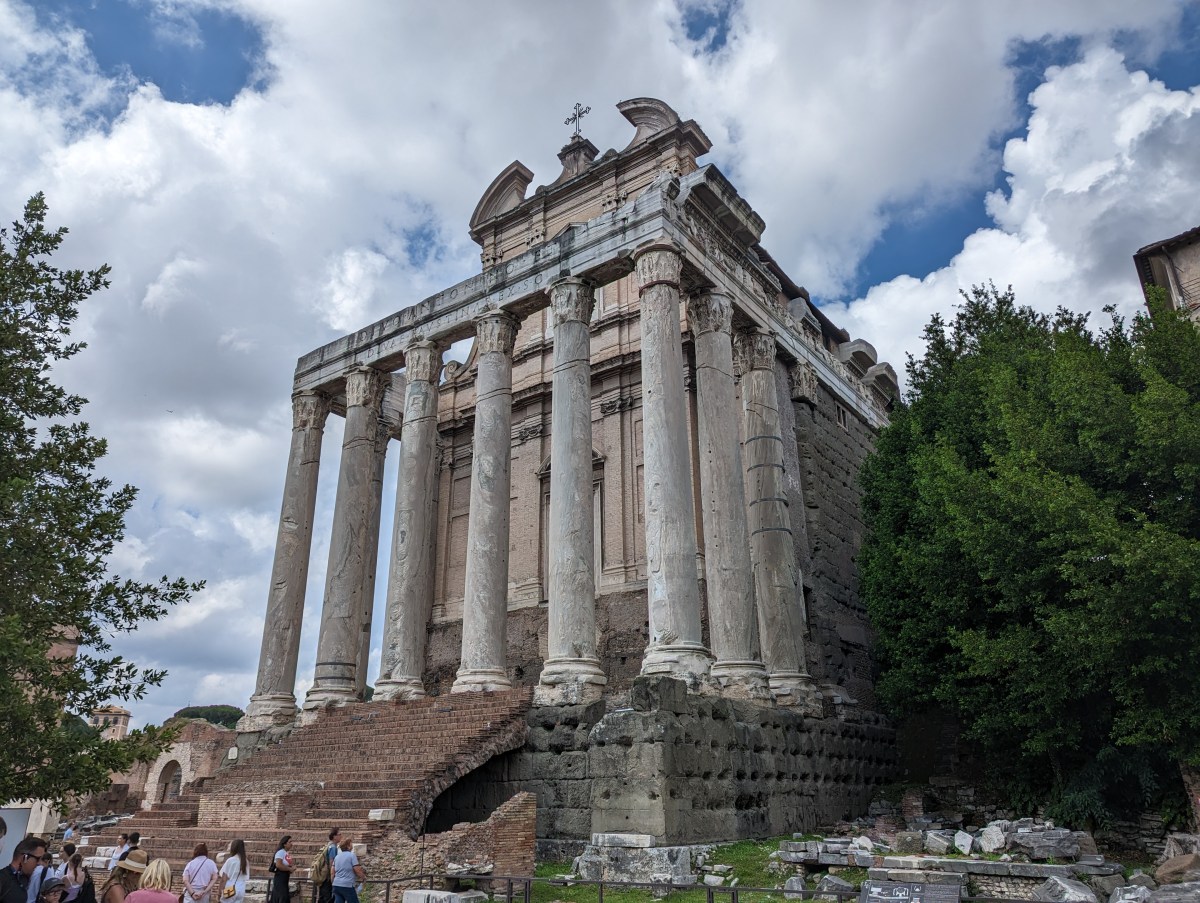
Arriving in Rome, we dived headfirst into its ancient history and it’s most iconic sights, ‘The Colosseum, the Roman Forum and the Palatine Hill’ which still stand as monumental reminders of the city’s glorious past. Immersing ourselves in the awe-inspiring ruins, we (Calv in particular) marvelled at the ingenuity of the ancient Romans;  the Colosseum delivered everything promised, the Roman Forum was never ending – with sight after sight and the Constantine Arch stood guard over everything. 

However, we were constantly harangued by those trying to sell overpriced tour tickets – telling us the official queue (which wasn’t well managed) was 4 hours… (it was about 1 hour – quite long enough!)  The ticket gets you entrance to all 3 attractions – we would have spent the extra 6Euros to visit ‘the underground’ of the Colosseum, but unfortunately it was sold out for the day ☹

Throughout Rome, whatever faults there may be, there is an abundance of water fountains available to fill your bottles. 

From the Roman Forum and the Palatine Hill we could see a huge monument which we didn’t discover until our 3rd day of exploring – it was well worth it 😊

These 3 attractions are in a very compact area, and we were therefore able to use the same metro to head home as we arrived at (there are not a huge number of stations to choose from unfortunately..)

Day 2: The Vatican City: On the second day, we set our sights on Vatican City, a city state within Rome.  Once again, not well signposted from the minimal metro network, but we managed to find our way in the end. 

There was a long queue for the Vatican museums (buying a ticket is the only way to see the Sistine Chapel unfortunately – as I wasn’t overly bothered about the museums we decided to give this a miss (which doesn’t stop the ticket sellers from haranguing you every step you walk)) 

Instead we headed straight for St Peter’s Square (again minimal signage to help you to negotiate the city and find the main sights).  But once there we loved the grandeur of St. Peter’s Square, where the faithful gather in the shadow of the magnificent St. Peter’s Basilica. On this day they were preparing for a large gathering to be held in a couple of days.

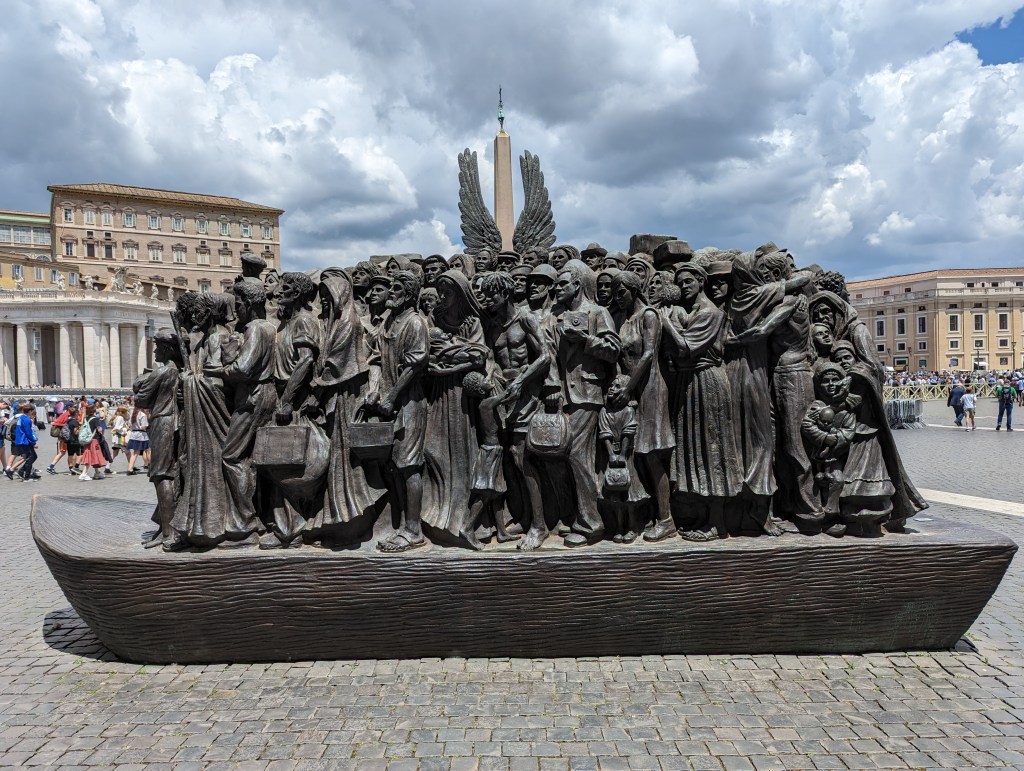
The square itself is beautiful including a wonderful fountain (which provided a very welcome shower of spray) and a statue honouring all refugees over time.  There is also a post office, which, had I realised or thought about it, I would have gone into to post a couple of postcards and perhaps had my passport stamped.  But I didn’t ☹

Returning to visit the basilica later in the day, the opulent interior almost left us speechless.  Note: the queues look longer than they actually are and are mainly to get through the airport type security that you will experience throughout Rome.  Entrance to the Basilica is free and I would absolutely recommend it.

After lunch we headed to the Castel Sant’Angelo which stood as a testament to Rome’s layered history.  Well worth the 12Euros entry fee, there is far more to this castle than you might first think.  We arrived at a quiet point and didn’t have much of a queue.  It was a lovely surprise wandering around discovering the delights of this attraction.  There is a café/restaurant on a terrace near the top level which might be worth a visit for lunch.

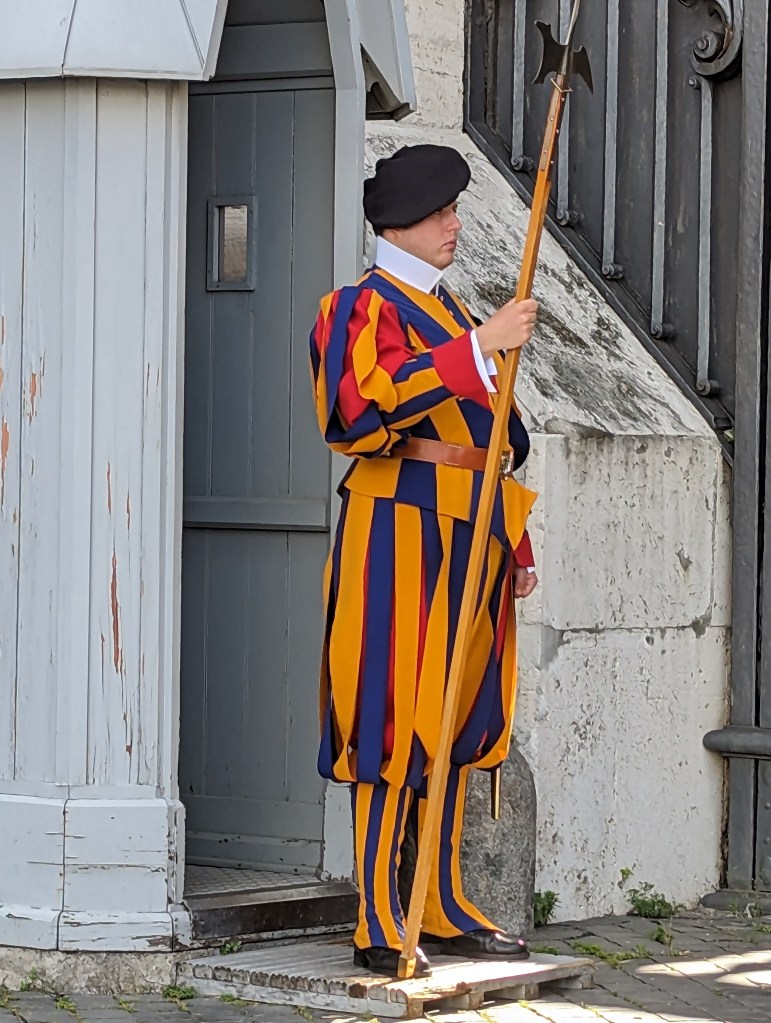
Having returned to visit St Peter’s Basilica we were delighted to spot a couple of Swiss Guard in their iconic uniforms (never too happy to have their photos taken of course!)

We then, accidentally, exited the square and headed in the wrong direction (we turned right…) which resulted in us walking the entire circumference of the Vatican City’s towering walls in the course of the day, which is really not a particularly pleasant way to complete your visit!!  And it was, of course, my fault….

Day 3: A Day of Rest: After two days of intense exploration, we decided to take a well-deserved break. It was a day of relaxation, basically doing a spot of washing and heading to the swimming pool to cool off 😊

Day 4: The Heart of Rome: On our final day, we ventured into the historic heart of Rome, to visit the last few sights on our list – the Spanish Steps, The Trevi Fountain and The Pantheon.

I had hoped to also visit the Piazza Navona, but a wrong turn early in the day (☹) and lots of walking around the busy streets meant that we didn’t make it.  We did however discover some other sights that weren’t on our list – the Vittorio Emanuelle II monument (including the tomb of the unknown warrior) and the Teatro  Marcello.

First stop was the Spanish Steps, accessed from the Spagna Metro station.  The fountain at the bottom of the steps was quite impressive (and you could refill your water bottle here), but the steps themselves were largely obscured by the hordes of people on them.  We did, of course, walk up, and down and then headed through the shopping district (where I did buy a new bikini…) in search of the Trevi Fountain.

Having initially walked the wrong way and unintentionally visited Piazzale Flaminio, we eventually found the Trevi fountain.  Again a very impressive sight, but heaving with tourists.  It is huge!  I chose not to throw any coins in….

Last up was the Pantheon, but on the way we found the Vittorio Emanuelle monument, which was very impressive, and from which you can look over the Roman Forum and Palatine Hill. From there we spotted what looked like a mini colosseum, but was in fact the Teatro Marcello, an ancient open-air theatre that was completed in 13BC – very impressive 😊

When we eventually found the Pantheon there was a short queue to visit.  It was much smaller than I expected, but no less impressive for that.  Definitely worth the long walk to find it!

Conclusion: Staying on the outskirts of Rome and commuting in from Due Ponti allowed us to experience a different view of Rome than most who visit will see.  This means that we don’t see the ‘fully sanitised’ version of the city, but rather the full reality, including walking through the less salubrious districts and ‘enjoying’ the real experience of commuting into the city (the trains and stations are very dated).

We very much enjoyed our time in Rome and saw all the sights that we wanted to.  We’re glad that we went but we wouldn’t return (hence why I didn’t throw any coins into the fountain!)

Next stop on our Italian Adventure: Exploring  Lucca and Pisa

The next stage of our Italian roadtrip taking in Lucca and Pisa 🙂

We set off from Celle Ligure hoping for a relaxing, picturesque run along the coast road to our next destination near Marina di Massa.  Unfortunately it wasn’t to be; the road was far from picturesque or relaxing, so after suffering the clogged outskirts of Genoa, we decided to jump onto the toll road, which turned out to be surprisingly affordable (14.30Euros to go 73 miles). We looked forward to arriving in Marina di Massa, but were unfortunately rather disappointed on arrival. 

The campsite, Camping Giardino, was not what we had been expecting and trying to find a supermarket was very frustrating involving cycling along a busy, uninspiring road to find a Carrefour Express with very poor produce ☹

However, the next morning brought a renewed sense of optimism as I ventured out for a short run along the coast.  I ran the other way to where we’d cycled the previous day, which offered some slightly more promising scenery.  We were in need of a rest though and chose to chill out by the van and around the pool for the day.  We forgot to take our swimming hats though and chose not to use those that were offered to us (they’d clearly never been washed…)

We had some British neighbours for the first time and they told us about the region’s abundant marble quarries of Carrara. We had seen much evidence of this on our drive, seeing huge marble slabs waiting to be transported.  Our neighbours had a motorbike with them and went up to undertake the quarry jeep tour, which they said was amazing.

After a restful 2 nights we moved on, passing through the much nicer area of Marina di Massa just a mile or so up the road…

Our next stop was the enchanting city of Lucca, a place that quickly won our hearts. We stayed at the dedicated motorhome parking area of Parking Luporini, which was absolutely perfect 😊

We had a quick wander down to the town in the evening but saved our main exploration for the following day when we were greeted by a vibrant and bustling atmosphere. Having to negotiate the city’s streets, competing with an eclectic mix of bikes, mopeds, delivery vans and even rubbish trucks was most certainly an experience! Even the supposedly pedestrianized areas were not immune to the bustling energy of daily life.

While in Lucca, I took the opportunity to collect a unique souvenir—a fridge magnet crafted by the talented artist Maria Guida. It serves as a charming memento, capturing a piece of Lucca’s spirit that I will keep with me.

Sadly, our visit to the iconic Torre de Guinigi was thwarted by its closure for maintenance. Nevertheless, we found solace in the city’s beautiful cathedral, its architectural splendour a testament to Lucca’s rich history.

For lunch, we discovered Undici Undici, a quaint restaurant with a mesmerizing view of the cathedral. The ambience was enhanced by the warm hospitality of a lovely waitress, who added a personal touch to our dining experience.

Later in the evening, as the sun set, we embarked on a bike ride atop the city walls, immersing ourselves in the vibrant tapestry of Lucca’s evening activities. The walls were alive with walkers, scooter riders, and an abundance of runners, all enjoying the shared space and the city’s unmistakable charm.  From here we were able to appreciate all the sights of Lucca from a different perspective.

I wanted to start the day with a run along the city walls, but found myself succumbing to exhaustion from all the walking the day before!

From Lucca, we had just a short journey onto Pisa, where we finally fulfilled our long-held dream of seeing the leaning tower. The tower did not disappoint, and we realized that pictures alone cannot do justice to its unique lean.

The cathedral and baptistery in the Piazza dei Miracoli were equally impressive. We learned that the leaning tower started leaning during its construction but has been stabilized to prolong its lifespan – it’s thought by a further 300 years.

After enjoying a drink just outside the city walls, we walked along the city walls before finding our way back to the motorhome parking area, Camperisti Pisani, which had the added bonus of an old, abandoned running track nearby – so at least I managed to get a run in this time 😊

Our next destinations were Florence and Siena, and I will include details of both in my next post 😊

Note: for more photos see my instagram & facebook posts 🙂

https://www.instagram.com/turnrightoutofportsmouth/

https://www.polarsteps.com/turnrightoutofportsmouth/7279815-italy-etc-2023

A Scenic Road Trip: Chianocco to Cuneo to Celle Ligure, Avoiding Toll Roads

We all know that embarking on a road trip offers us an opportunity to explore hidden gems and embrace the freedom of the open road. In this post, I’ll take you on a journey from Chianocco to Celle Ligure, avoiding the toll roads.

Along the way, we stopped overnight in the charming town of Cuneo, with its fascinating history and laid-back atmosphere. From there, we continued to Celle Ligure, where the initial black gritty beaches morph into something a little more inviting.

Chianocco to Cuneo: We took the scenic route towards Cuneo, having made the decision to avoid toll roads wherever possible. At this stage we were happy with our decision and were finding that the roads weren’t THAT bad (certainly no worse than the toll roads in Portugal!)

Upon arrival in Cuneo, we quickly found our free park-up (okay there was a slight hitch, but that was our fault!) – at first it appeared to be full (as there was a sign on the barrier (which was up) saying ‘Complet/Full’).  However, it wasn’t and in addition the terminal for payment was broken so we weren’t able to pay our 5 Euros – we would happily have paid as we had all services, including electric.   We shared the sosta with a few occupants who did appear to be, shall we say, very at home there – they were quite loud, checking on anyone arriving and even cutting branches off the trees!

From the car park, a lift takes you up to the heart of town, where the enchanting Via Roma awaits.

The first thing we noticed though was a sign detailing a 5k running route along an avenue and back – I fully intended to take advantage of this in the morning.  But it was raining.  Hard ☹ (I had also thought that I might take advantage of the swimming pool – but I didn’t do that either!!)

We strolled along this beautiful street (Via Roma), lined with beautiful architecture and many shops.  This is where we found a Vodafone shop and managed to get 100gb of data 😊

We then made our way to Piazza Vittoria, a central square known for its lively atmosphere and the poignant speech given by Ducca Galimberti when Mussolini’s regime fell. This historical moment is deeply etched into the city’s identity.  There is a recreation of the speech being given on the balcony where it happened.  Read more about Ducca Galimberti’s story here.

We then visited the magnificent Duomo di Cuneo, where we were fortunate enough to wander in during an organ practice, the sound reverberating through the grand cathedral. We took a moment to admire the intricate details of the church’s architecture and soak in the peaceful ambiance.

Cuneo to Celle Ligure: Moving on from Cuneo, we headed south (again avoiding the toll roads) towards Celle Ligure. As we hit the coast road, we noticed that the beaches were of the black gritty variety.  As it was raining still I don’t think we had the best views of the Ligurian Sea!

However, on arriving in Celle Ligure we realised that here the beaches were different, being of sand.  Not quite golden but certainly a more appealing hue 😊

This was quite a hard drive along the coast roads, and we had to head towards the motorway to reach our aire, this time navigating a series of switchbacks up the hill (this holds no fear – Calv drove the Mont Cenis Pass!!) 

Once set-up and fed the rain eventually stopped and we ventured out down the steep hill (already with the dread of having to come back up it!) to explore a little of Celle Ligure.  This is a coastal town exuding charm and character with multi-coloured villas, street art and a walk/cycle tunnel (Galleria Crocetta), a unique attraction housed within a former train tunnel. This repurposed space now occasionally hosts various exhibitions, showcasing contemporary art and cultural events.

It would appear that in Italy you may have to pay to visit many of the beaches – we have noticed signs showing short stretches where it’s free.  We also noticed that in just a short stretch of the seafront Celle Ligure had 2 lidos.  It was a very relaxing wander until we had to make our way back up the steep hill to our van!

In summary travelling from Chianocco to Cuneo to Celle Ligure without taking toll roads is certainly achievable and provides a delightful journey through history and coastal charm. Cuneo’s rich heritage, highlighted by the lift to town, Via Roma, Piazza Vittoria, and the Duomo, offers a taste of Italy’s past contrasts with Celle Ligure’s seaside vibe, but both were worth a visit in their own right.

However, I think, with hindsight, that we should have driven further east from Chianocco before taking the road down past Genoa as we headed further South. 

My next post will look at the last week or so, including staying near Cassara and the marble quarries (we didn’t visit – we just needed to stop!) and then moving on to Lucca, Pisa and, presently, Florence 😊

Note: More photos can be found on my instagram, (https://www.instagram.com/turnrightoutofportsmouth/) and facebook (https://www.facebook.com/profile.php?id=100028126913740) pages

Traversing the Mont Cenis Pass: A Motorhome Adventure from France to Italy

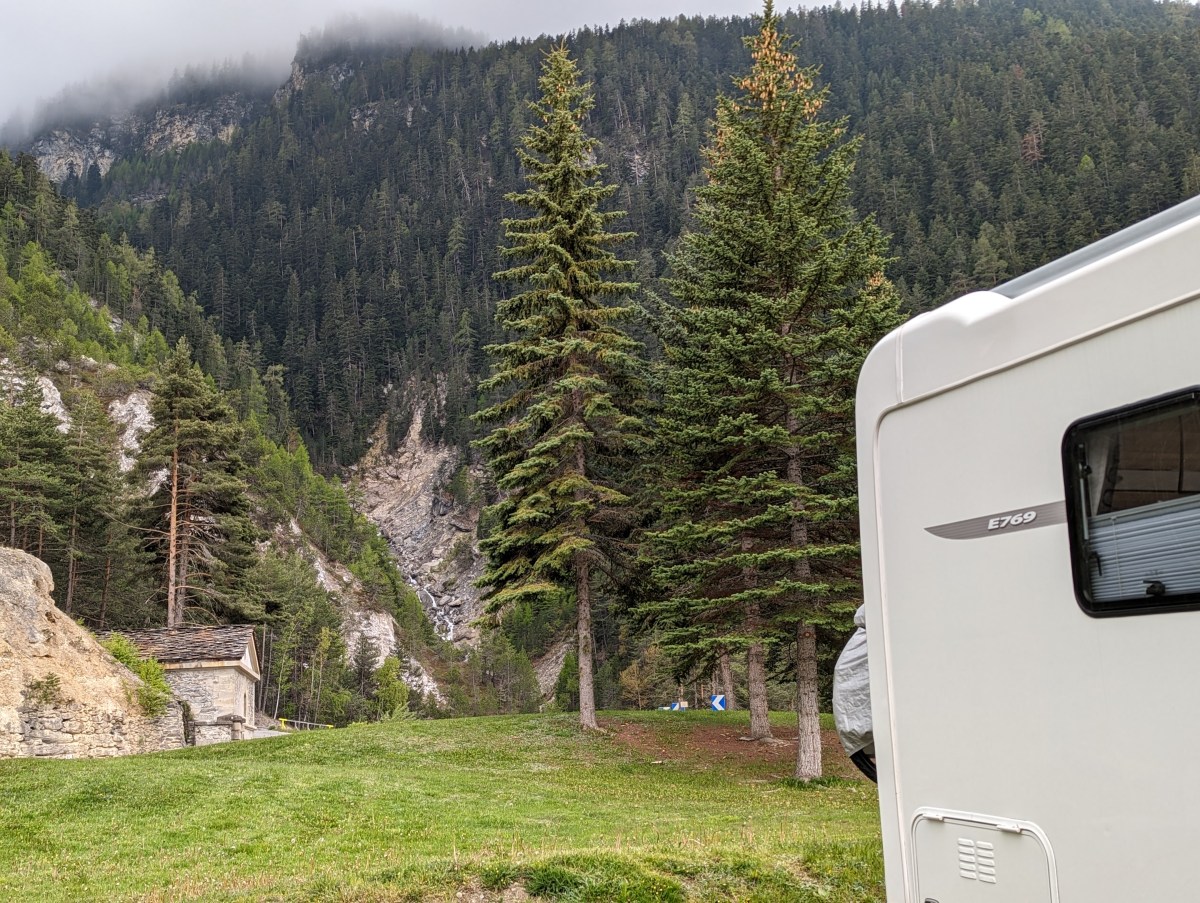
We unexpectedly ended up heading through the stunning Mont Cenis Pass, to get from France to Italy, and it was an experience that delivered breath-taking views, thrilling twists and turns (lots of them) and an abundance of historical and natural wonders to enjoy. This scenic route gave us Fort Marie Therese, from where you can take several via ferrata routes on the Via Ferrata du Diable up to Fort Victor Emmanuel; stationery chairlifts hanging empty and silent just metres above us; a beautiful lake at the summit and the remains of Grand Croix abandoned village which was the only village ‘saved’ when the dam was built and all the other local villages were flooded. Join us as we take you on a captivating journey through this picturesque mountain pass.

Fort Marie Therese and Via Ferrata: As you make your way through the Mont Cenis Pass, a stop at Fort Marie Therese is almost impossible to resist. This impressive 19th-century fortress offers up a large car park, a snack bar (not open when we visited), toilets, high ropes courses and picnic tables. We stopped to drink in the amazing scenery.

Serene Lake and Grand Croix Abandoned Village: After winding our way through the twisty, steeply climbing roads and hairpin bends, we were eventually greeted by the serene beauty of Lake Mont Cenis. Not particularly blue on the day we passed by, and with the water level not as high as it really should be, it is still breath-taking and certainly merited stopping, again…. At the head of the lake we stopped for a spot of lunch while it snowed lightly outside the van 🙂

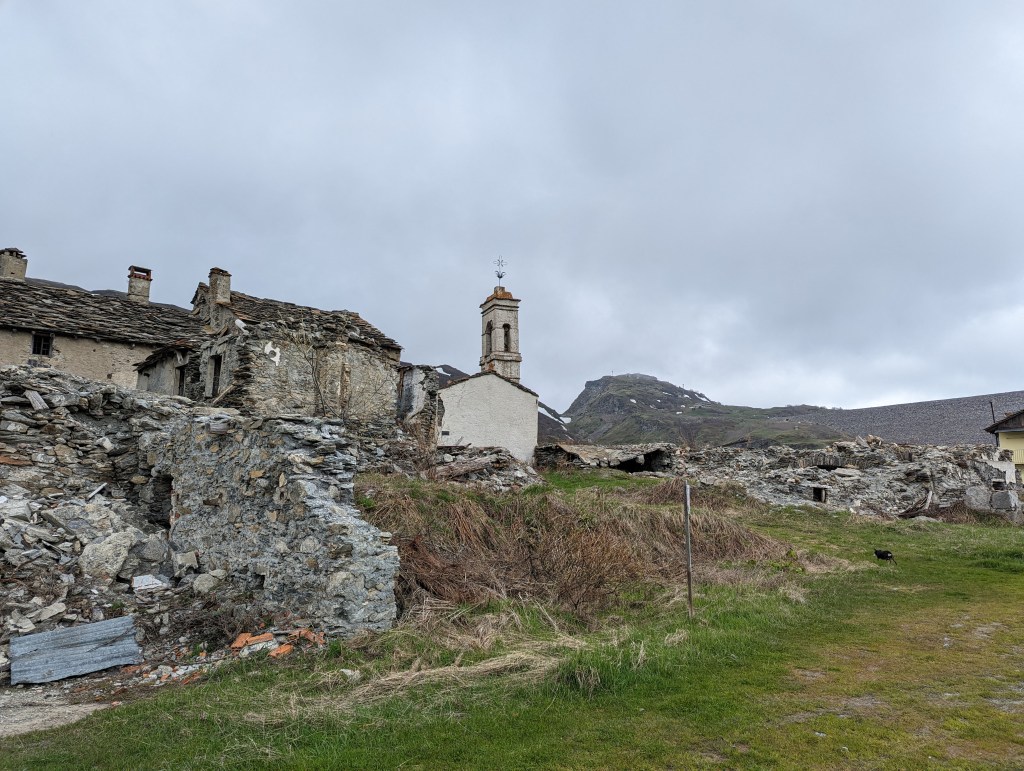
As we began our descent towards Italy and just a short distance from the lake, we stumbled upon the ghostly Grand Croix abandoned village – I say stumbled, we could clearly see it from our lunch spot, but it wasn’t clear just how abandoned it was from there. Frozen in time, this ghost town offers a hauntingly beautiful sight. We explored the crumbling houses (I waited for Calv to head back to the van to get his raincoat before venturing inside 1 of the buildings) and overgrown paths, and imagined the lives that once thrived in this remote location. It would appear however that the chapel is still in use (much like the church in Dorset’s abandoned village of Tyneham). As we left I spotted the sign saying it was too dangerous to enter (as I said to Calv I’m not daft, and I was careful to not step anywhere dodgy…)

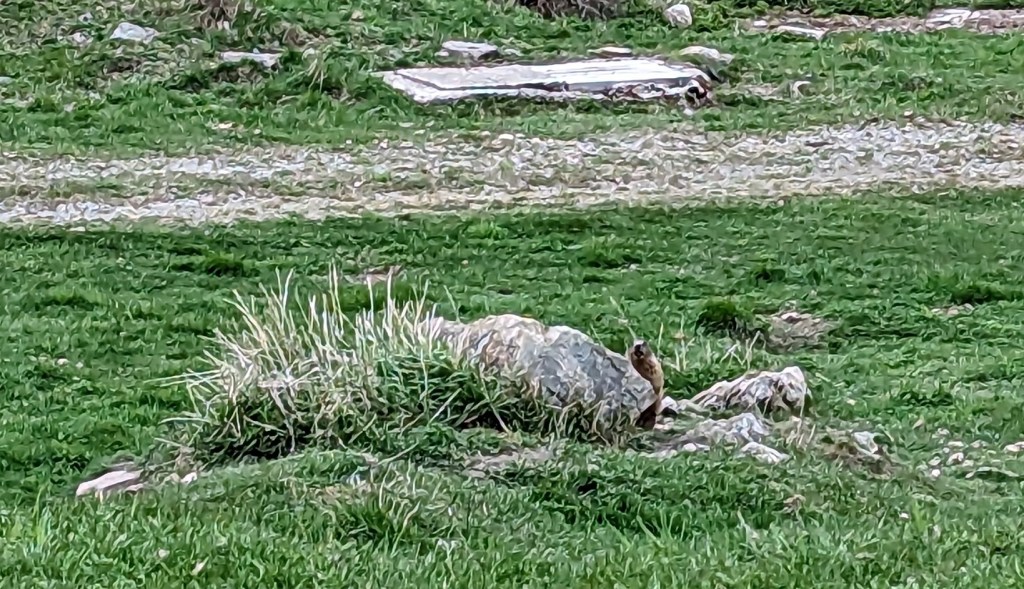
Customs and the Border: The village is behind a large car park and hut. This is the customs hut (no longer used). This isn’t the actual border as we first thought (hence the daft photo – we thought that 1 of us was in France and the other in Italy…), but where the border is, a little way further along the road, there is no possibility of a customs point. There is also evidence of the original road here. Whilst at the village we spotted some more Marmots running around and hiding from us behind clumps of grass – although we could still hear them squeaking to each other (and, who knows, perhaps to us as well 🙂

Overnight in Chianocco: By the time we were in Italy we were shattered, so made a quick stop at the first Lidl supermarket we saw – Calv stayed in the van whilst I went in to get a couple of essentials (it would appear that Lidl in Italy is way better than Lidl in France).

For our first overnight stay in Italy we headed up just beyond Bussonelo to the village of Chianocco. We parked up amidst the scenic beauty of the countryside enjoying views of mountains and grapevines, and enjoyed a restful night’s sleep after sitting out for the 1st time on our trip (with coats on though!!). This set us up nicely for our onward journey south through Italy (starting with a stay in the beautiful city of Cuneo)

Conclusion:

We’re so glad that we met up with Gary from @Happy2Dream who persuaded us (although it didn’t take much to be fair!) to abandon our plans to go through the Frejus tunnel (which would have cost us at least 68Euros – probably more like 80Euros) and head over the pass.

Because driving over the Mont Cenis Pass, even in an 8.5m motorhome, from France to Italy gave us an unforgettable experience, and is the highlight of our trip so far 🙂 (especially the village of Grand Croix). I watched Calv enjoying every minute of the drive – he said it’s so much better than using the motorways 🙂

So, if this is something that you’ve considered and dismissed, or are still undecided, our advice is to go for it (unless it’s snowing….) You won’t regret it – we didn’t 🙂