


Introduction: Visiting Pompeii has been a long-held childhood dream of mine, and finally, the time came to visit & explore the ancient city. We stayed on the outskirts of the city which meant a rather uninspiring and not particularly enjoyable walk of just over 1-1.5 miles into Pompeii; note, we had to endure this walk 6 times (3 x there and back), but it was worth it for what we saw. Pompeii exceeded all expectations and proved to be a place where time seemed to stand still. Ever since our visit Calv has commented with ‘It’s not 2,000 years old though is it?’ to every new sight that we’ve seen…. We didn’t limit ourselves to visiting Pompeii though – we also ‘conquered’ Vesuvius and explored Herculaneum 😊
Pompeii: A couple of people advised us that we needed to allow about 2 hours to exploring the ruins…I know, right?? 2 hours?? Were they mad? We could have spent 2 days nosing around and probably still not seen everything. We spent about 5 hours exploring and barely scratched the surface. Our feet were screaming at us by then in the heat; we did intend to go back a 2nd day but by the time we got back from Herculaneum (and knowing we still had another 1.5 miles to walk) we simply couldn’t face it (I’ll just have to return another time)
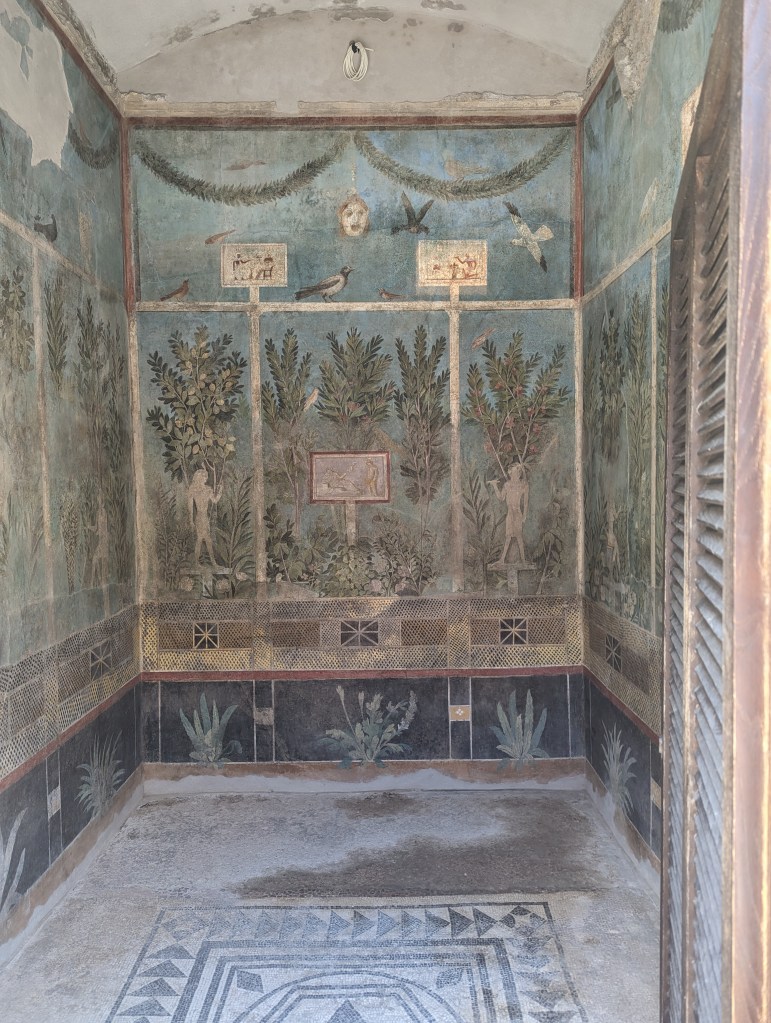
Wandering through the ancient streets, we marvelled at the remarkably well preserved ruins, the wheel ruts along the streets, the high pavements and stepping stones across the streets, the numerous ‘fast-food’ outlets with the amorphae still in place, the mosaics, the friezes, the fountains – the list is endless. The ampitheatre was amazingly well preserved. We were aware of many archaeologists working around the site uncovering more of it all the time (I think that only 2/3 of the site has been uncovered so far) – you can see the depth to which it was buried where excavations have yet to begin.
Finally we wandered through the ancient burial area before viewing the preserved skeletons – they’re actually reproductions that you see, but very poignant nonetheless.
It was a simply amazing visit and I cannot recommend it highly enough.
Note: If you enter near the Ampitheatre entrance there is likely to be less of a queue (we didn’t even have a queue – we thought we did but, we got into the queue only to realise that it was actually for the audio guides!) We just needed to go to the ticket machine and buy our tickets and go on through 😊




‘Conquering’ Vesuvius: We wanted to go up Vesuvius and, preferably, look over the crater but we were being offered ‘tours’ for 45E each, that consisted of, in effect, a taxi ride to Herculaneum and then up to Vesuvius (not including tickets), so we decided to make our own way to both sites. However, our plans hit a roadblock when we discovered that tickets to see the crater were sold out for the next two weeks. No doubt due to the opportunistic operators buying up all the tickets so that tourists have little choice if they want to see the crater. Determined to explore on our terms, we managed our own transportation (we used the local bus and were lucky to get a fairly sane bus driver) and saved a significant sum of money (about 50E), AND saw just as much as we would have done if we’d fallen for it.
On finding the ticket office closed and therefore a short hike up to the crater closed to us, we took an alternate route up the mountain, which afforded us much the same views as we would have seen the other way (but without the crowds). We could now easily see that Vesuvius is actually a volcano within a volcano as we could see the outline of the older Somma clearly.
Calv genuinely believed that we would fool ‘the authorities’ and make it up to the crater on this alternative route…. He was proved wrong when we were stopped by a ranger and asked if we had a ticket (it costs 12E each to look in the crater… assuming you can get a ticket that is…)
We loved the hike that we were able to undertake but, in all honesty, I find the hike up and the views from Snowdon to be very much more stunning. Everyone’s different and I’m sure there will be those who disagree with me on this (not many though!!).


Herculaneum: Pompeii’s Lesser-Known Gem
While Pompeii often steals the limelight, its smaller counterpart, Herculaneum, offers an equally interesting view of the calamitous events of 24th August 79BC.
After our adventures in Pompeii and conquering Mount Vesuvius, we hopped on a commuter train from the same location that we had taken the bus, ready to explore the lesser-known ruins of Herculaneum. we needed to use was the commuter train and couldn’t help but notice the need for modernization throughout the whole train system (something that has been clear to us on most of our train journeys in Italy). However, amidst the worn-out stations and dated trains, we did notice one station that had either been recently upgraded or was completely new—hopefully, for the Italians who have to use this infrastructure daily, a sign of things to come? The short ride to Herculaneum was a true reflection of the local daily commute, adding an authentic touch to our overall experience and what awaited us at Herculaneum made the journey worthwhile.
On arriving in Herculaneum (Ercolano as it is known nowadays) a brief walk from the train station brought us to the entrance to the ruins. As we crossed the bridge, we were able to look over the entire site – it is vastly different in size to the Pompeii ruins. We could see whole buildings along whole streets, some with 2 stories still intact. Due to the nature of the explosion and the fact that Herculaneum was much closer than Pompeii it was buried in a different way, from the bottom up, which meant that buildings were less likely to collapse and therefore the site seems to be more complete.
The ruins of Herculaneum, while smaller than Pompeii, were no less impressive. Our eyes were immediately drawn to the remarkable 9-meter-long wooden boat, a fascinating artifact that showcased the advanced maritime technology of the time. Additionally, the abundance of gold jewellery on display transported was amazing for the fact that you could imagine many of the pieces being on display in any jewellers today.
While some areas, such as the “urban baths,” were closed during our visit, we made it a point to explore all accessible sections. Learning from our previous experience in Pompeii (aka a ‘scatter gun approach’), we became more circumspect, ensuring that we didn’t miss any hidden corners or intricate details. Herculaneum, with its well-preserved structures and intimate atmosphere, allowed us to immerse ourselves in the daily life of its ancient inhabitants.
Once satisfied that we had seen everything, we treated ourselves to a light lunch at VIP Burger, a nearby eatery. The friendly staff seemed delighted to have customers and provided exceptional service (sadly not always evident during our trip). We even encouraged fellow travellers to take a seat and order here – it was a simple lunch but very tasty 😊
With our feet tired from hours of walking and my long-held dream finally fulfilled, it was time to bid farewell to Pompeii, Vesuvius and Herculaneum and embark on the next leg of our journey—heading towards the East Coast.


Conclusion: Visiting Pompeii fulfilled a cherished childhood dream, immersing us in the rich history and awe-inspiring ruins of this ancient city. The experience taught us that two hours are simply not enough to explore the vastness and intricacies of Pompeii’s archaeological marvels. Having said that, 2 hours is almost enough time to explore Herculaneum- we would perhaps suggest that you go to Herculaneum first, and then Pompeii on a different day. Additionally, our conquest of Mount Vesuvius, despite the unexpected challenges, rewarded us with remarkable views and a sense of accomplishment. As with any journey, it’s not just the destination that matters, but also the lessons learned and the memories created along the way.
Where we stayed: La Terraza di Hermes










 turnrightoutofportsmouth